


Minecraft version
Back to mods 
CurseForge · Minecraft mod
Celeris
A performance library for NeoForge mods: off-heap memory, lock-free concurrency, SIMD math, compression and graph/network utilities, each with a pure-Java fallback so it runs on any JVM without launch flags.
Choose a version Pick your version below, then grab the matching file.
Quick answer
Which Celeris release matches 26.3 NeoForge?
Best match for your filters 0.2.2 26.1–26.3
Game version 26.1, 26.1.1, 26.1.2
Loader NeoForge
Celeris 0.2.2 26.1–26.3 targets 26.1, 26.1.1, 26.1.2 with NeoForge. The project page does not say whether this file belongs on the client, dedicated server, or both. No extra mods listed for this file.
Where it goes
Is Celeris required on the client, server, or both?
The project page does not say whether this file belongs on the client, dedicated server, or both.
Client Source doesn’t say
Dedicated server Source doesn’t say
Loader for this release NeoForge
Required install it here Optional supported, not mandatory Not supported do not install here Source doesn’t say do not assume
The source does not explicitly classify this release as client-only or server-only.
What else does Celeris 0.2.2 26.1–26.3 need?
0.2.2 26.1–26.3 on 26.3 NeoForge. Every mod below is checked against that same setup.
This file does not list any required mods. Do not add a library just because a different file uses it.
This file does not list any required or optional mods.
Before you install it
Add Celeris without breaking your instance.
Built for Celeris 0.2.2 26.1–26.3 on 26.3 NeoForge. Pick another file and the loader, install side or required mods may change.
- 01
Stick to this file
Use 0.2.2 26.1–26.3. It targets 26.1, 26.1.1, 26.1.2 with NeoForge; another release may have different loader, side or dependency requirements.
- 02
Bring the mods it needs
This file does not list any required mods. Do not add a library just because a different file uses it.
- 03
Put it on the correct side
The project page does not say whether this file belongs on the client, dedicated server, or both.
- 04
Pick the file you checked
Use the “Get this file” button beside 0.2.2 26.1–26.3. It opens that exact file at the source.
About this project
What does Celeris add?


Celeris is a performance library for NeoForge and Fabric mods. It gives other mods fast building blocks so they can do heavy work without slowing the game down. On its own it adds nothing you can see in game: you install it because a mod you want needs it.
⚡ What it gives those mods
- 🧵 Work off the main thread. Heavy jobs run on worker threads and their results come back to the game thread through lock-free queues, without stalling a tick or a frame.
- 🧠 Less garbage-collector pressure. Large buffers live in off-heap memory, so big data does not cause GC pauses.
- 📐 Vector math. Bulk number crunching uses the CPU's SIMD units when Java allows it, and plain loops when it does not.
- 🗜️ Compression. Native zstd for mods' own data (no JVM flags needed) and deflate for network packets.
- 📦 Items in pipes. Networks that carry items from block to block, with no entity per item, that keep the items when pipes are placed, broken or saved.
- 🔌 Signal networks. Redstone-style graphs that only recompute what a change touches.
- 🏃 Batch physics. Thousands of entities and dropped items moved in one pass, following vanilla's movement rules.
🛡️ Safe everywhere
- ✅ Every fast path has a pure-Java fallback. If something can't run the fast way on your machine, Celeris uses the slower one instead of crashing.
- ✅ Optional on both sides of a connection: players without Celeris can join a server that has it, and you can join any server with it. A Fabric client can also join a NeoForge server with Celeris.
- ✅ Network payloads are size-capped and their headers are checked before anything uses them.
- ✅ The native code is checked with AddressSanitizer and UBSan in CI, and its results match the Java version bit for bit.
🏁 How fast
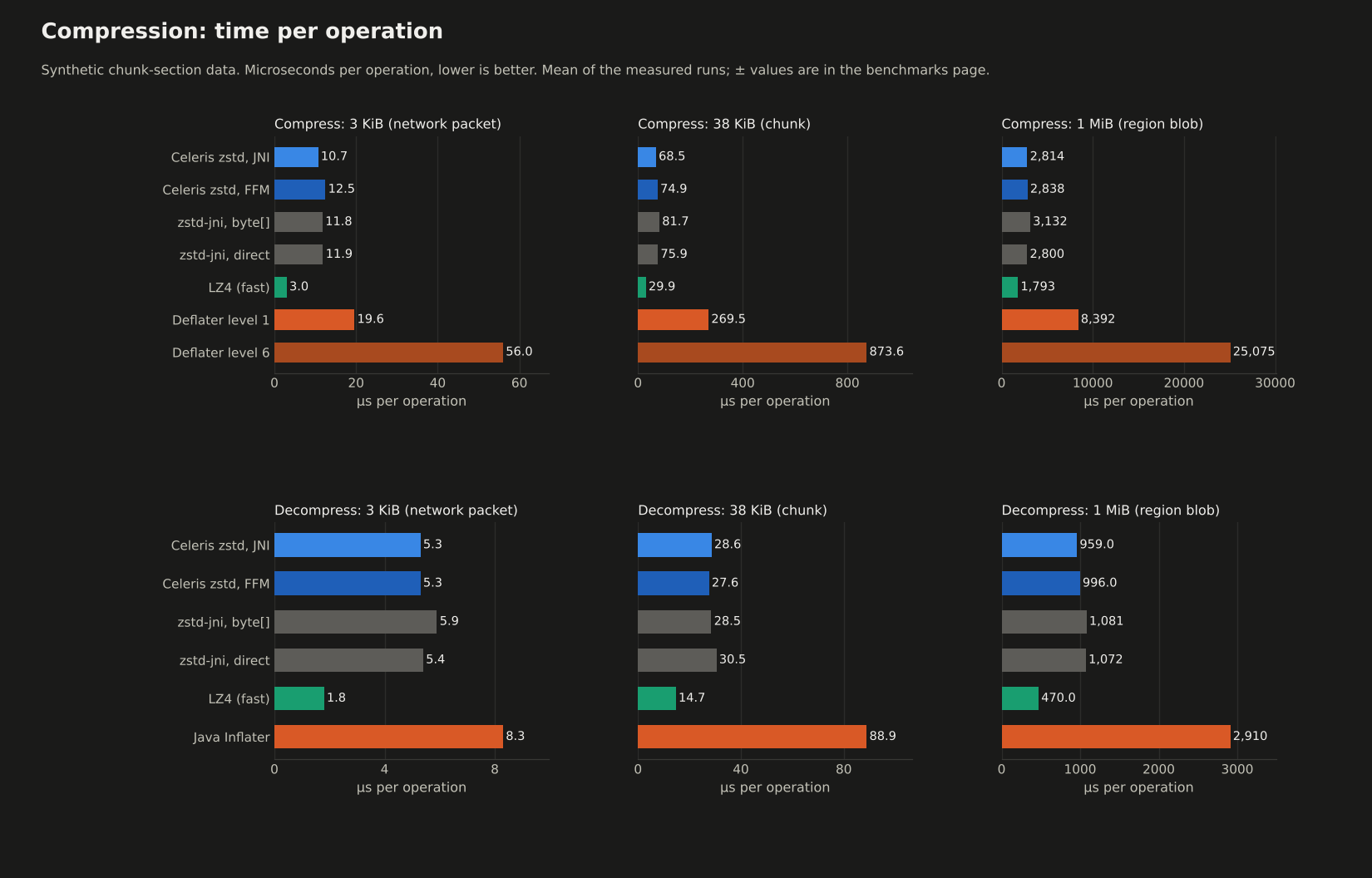
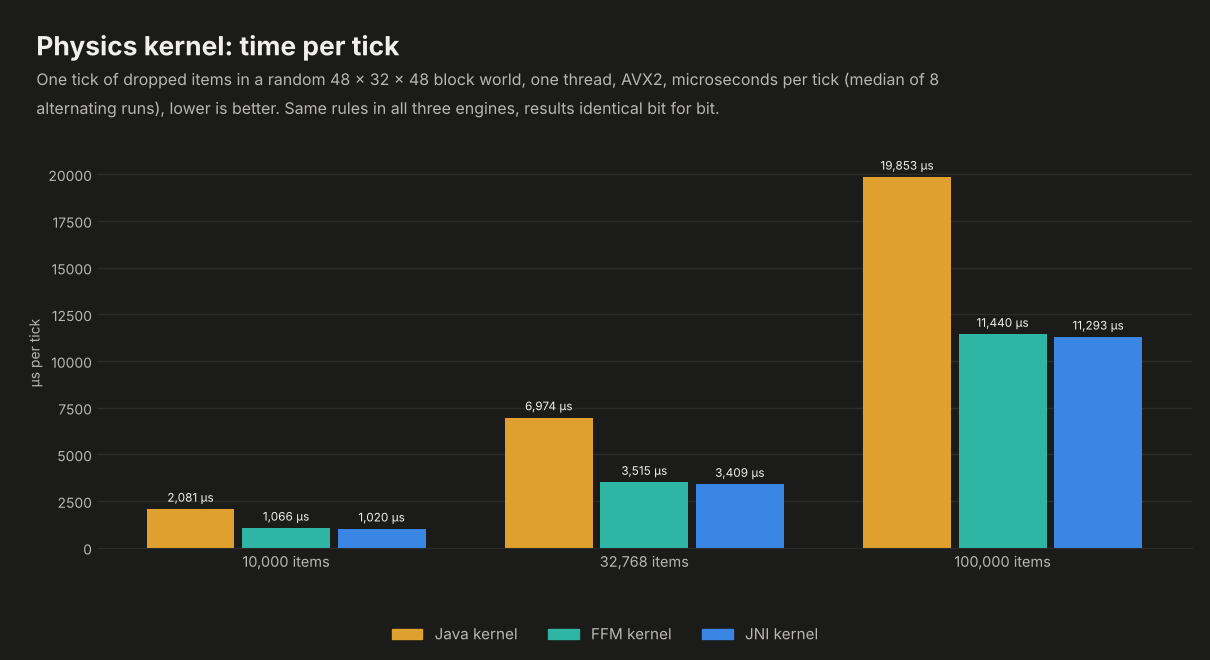
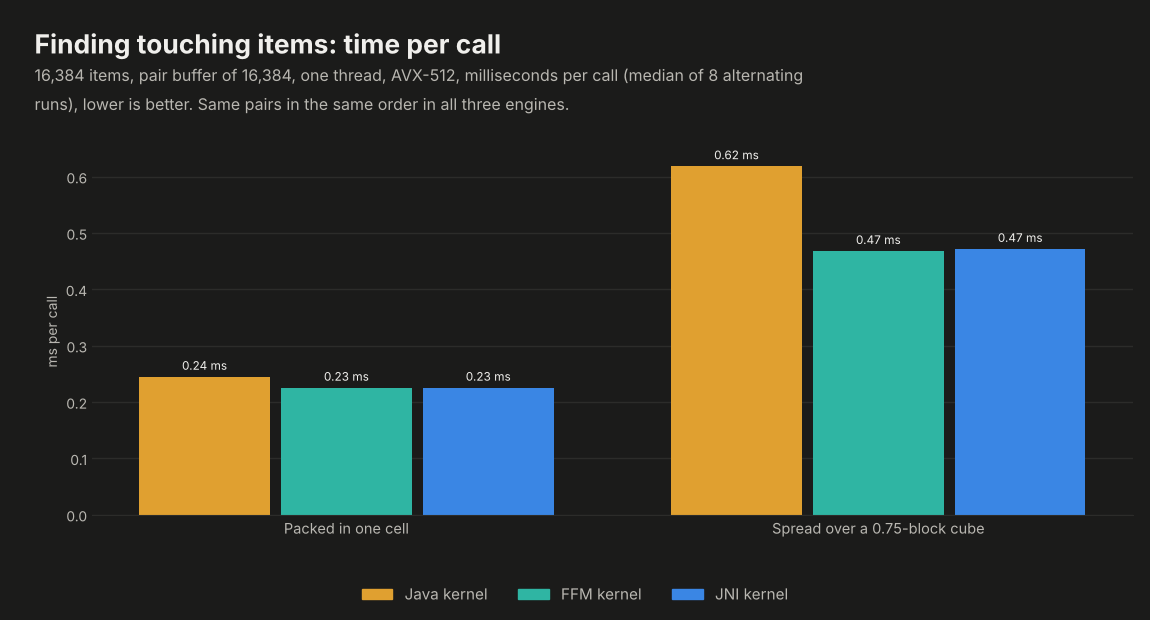
Each building block, measured against what a mod would otherwise use (JMH, Java 21, a 4-core machine; method and full tables in the benchmarks page):
- 🗜️ 12.8× faster compression than Java's built-in deflate (what Minecraft uses) for nearly the same size, and 3.1× faster decompression. As fast as zstd-jni in a jar a quarter of its size.
- 🏃 32,768 dropped items moved in 0.88 ms per tick on 3 threads with the native kernel, 5.3× faster than the same rules in Java on one thread and under 2 % of a tick.
- 🧲 Item piles no longer stall: finding the touching items in a pile of 16,384 takes 0.24 ms instead of up to a second.
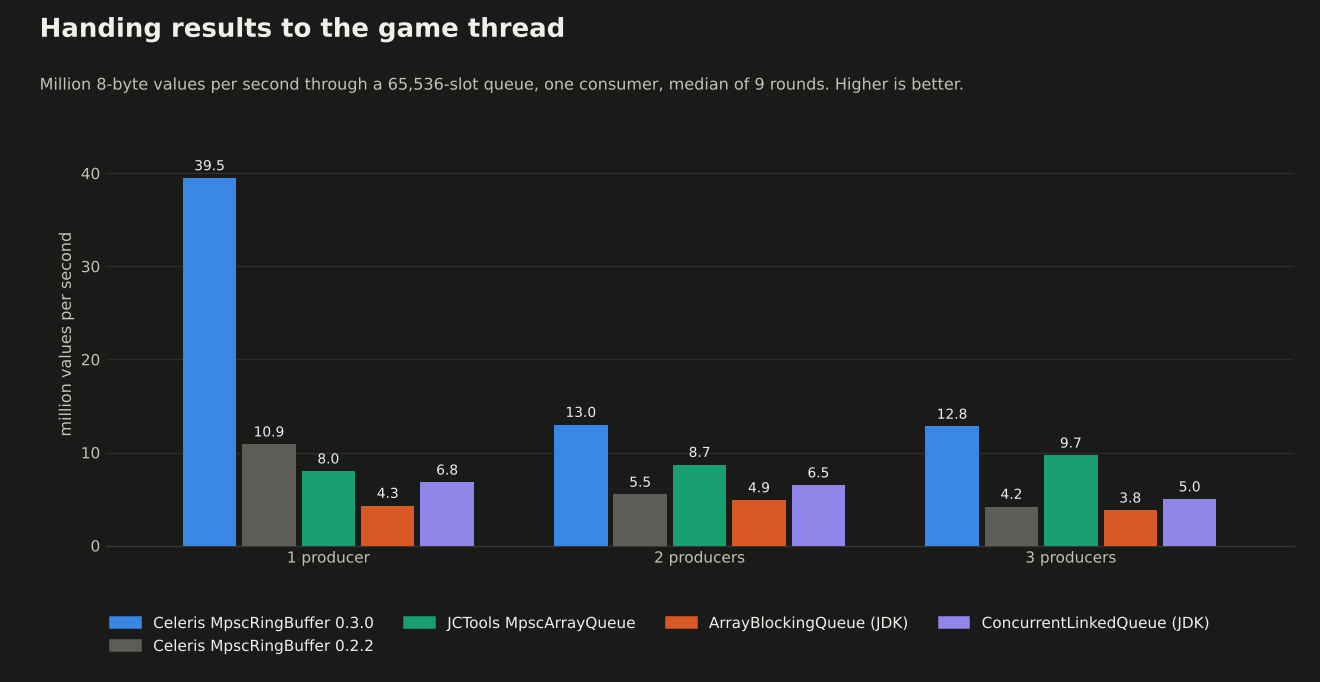
- 🧵 4.9× faster hand-off from one worker thread to the game thread than JCTools, and still ahead with two or three workers.
📦 Requirements
- 🟩 Minecraft: 1.21 to 26.3. Download the file made for your version.
- 🔶 Loader: NeoForge or Fabric (with Fabric API), on the client and on the server.
- ☕ Java: 21 for 1.21.x, 25 for 26.x.
⚙️ Settings
- Network compression level (0 to 9, default 1): how hard Celeris compresses the packets it sends. 0 sends them uncompressed, 1 is the fastest, 9 gives the smallest packets. Only the sender's setting matters.
- NeoForge: Mods → Celeris → Config, or
compressionLevelinconfig/celeris-common.toml. - Fabric: with Mod Menu, Mods → Celeris → Config; or
compressionLevelinconfig/celeris.properties(restart after editing it by hand).
- NeoForge: Mods → Celeris → Config, or
Optional JVM flags are on the wiki.
🔧 Native code
Celeris ships two native libraries, built from public source by GitHub Actions on each platform's own runner, from the same tagged commit as every file published here:
- zstd 1.5.7 (Meta's Zstandard, BSD-3-Clause), compiled from the official release tarball and checked against its SHA-256, plus a few small functions of Celeris's own that let Java 21 call it without extra flags:
native/zstd. - The physics kernel, Celeris's own C++ code:
native/.
GitHub releases also carry a Java-only file with no native code at all. See Native libraries.
📚 Learn more
The Celeris wiki has the settings, JVM flags, the guide for mod authors, performance numbers and how to build the project.


License
| Content | License |
|---|---|
| Source code | AGPL-3.0, see LICENSE-AGPL |
| Artwork, branding and documentation | CC BY-NC-SA 4.0, see LICENSE-CC |
| Zstandard (zstd) (bundled) | BSD-3-Clause, see NOTICE |
Source code: you may study, modify and redistribute it under the AGPL; if you run a modified version as a network service, its source must be available to that service's users.
Artwork: credit Bichal, no commercial use without permission, and share derivatives under the same license.
See LICENSE for the full summary.
Code: AGPL-3.0 · Art: CC BY-NC-SA 4.0 · Made by Bichal
Project description from CurseForge.
Pick your setup
Celeris by Minecraft version and loader
Choose the version and loader you play, then open the matching release.
Minecraft version
26.2
1 loader buildMinecraft version
26.1.2
1 loader buildMinecraft version
26.1.1
1 loader buildMinecraft version
26.1
1 loader buildMinecraft version
1.21.11
1 loader buildMinecraft version
1.21.10
1 loader buildMinecraft version
1.21.9
1 loader buildMinecraft version
1.21.8
1 loader buildMinecraft version
1.21.7
1 loader buildMinecraft version
1.21.6
1 loader buildMinecraft version
1.21.5
1 loader buildShowing the newest 12 of 17 game versions. Older files are in the list below.
Check the dependencies, then try the file in a copied instance before changing a world you care about.
Recent files
Celeris versions and loaders
0.2.2 26.1–26.3
celeris-0.2.2+26.1.jar
6 Oct 2026
Client Source doesn’t say Server Source doesn’t say Dependencies No extras listed Listed on Release listing
Check the 26.3 · NeoForge setup NeoForge26.126.1.126.1.2 release
Celeris 0.2.1 for Minecraft 26.1–26.3
celeris-0.2.1+26.1.jar
6 Oct 2026
Client Source doesn’t say Server Source doesn’t say Dependencies No extras listed Listed on Release listing
Check the 26.3 · NeoForge setup NeoForge26.126.1.126.1.2 release
Celeris 0.2.0 for Minecraft 26.1–26.3
celeris-0.2.0+26.1.jar
5 Oct 2026
Client Source doesn’t say Server Source doesn’t say Dependencies No extras listed Listed on Release listing
Check the 26.3 · NeoForge setup NeoForge26.126.1.126.1.2 release
0.1.0-26(.1-.3)
celeris-0.1.0+26.1.jar
2 Oct 2026
Client Source doesn’t say Server Source doesn’t say Dependencies No extras listed Listed on Release listing
Check the 26.3 · NeoForge setup NeoForge26.126.1.126.1.2 beta
Looking for an older file? The official CurseForge project page is in Resources.
 mod
CurseForge · Minecraft
Gnetum
Distribute HUD updates over multiple frames to improve performance
 mod
CurseForge · Minecraft
akilib
Shared library for Akicater's mods: custom block and item models, shading and tints, hand poses and compatibility helpers.
 mod
CurseForge · Minecraft
TONI's Better Shipwrecks: Sunken Ships & Pirate Wrecks (Forge/Fabric)
Every shipwreck rebuilt as a huge 3D ship: galleons, brigs, merchantmen, sloops and Viking longships, sunk or beached in many ways. Vanilla loot, server-side.