Groundworks Needed by Fieldworks 0.7.3
requiredMatching file found Matched file: Groundworks 0.7.1
CurseForge · Minecraft mod
Ore patches, oil fields and the Harvester that works them
Quick answer
Fieldworks 0.7.3 targets 26.1.2 with NeoForge. The project page does not say whether this file belongs on the client, dedicated server, or both. All 1 required mods have matching files.
Where it goes
The project page does not say whether this file belongs on the client, dedicated server, or both.
The source does not explicitly classify this release as client-only or server-only.
Fieldworks 0.7.3 on 26.1.2. Every mod below is checked against that same setup.
Install Groundworks first. We found matching files for this game-version and loader setup.
We only count dependency files that match this setup. A file for another loader does not fill the gap.
Before you install it
Built for Fieldworks 0.7.3 on 26.1.2. Pick another file and the loader, install side or required mods may change.
Use Fieldworks 0.7.3. It targets 26.1.2 with NeoForge; another release may have different loader, side or dependency requirements.
Install Groundworks first. We found matching files for this game-version and loader setup.
The project page does not say whether this file belongs on the client, dedicated server, or both.
Use the “Get this file” button beside Fieldworks 0.7.3. It opens that exact file at the source.
About this project
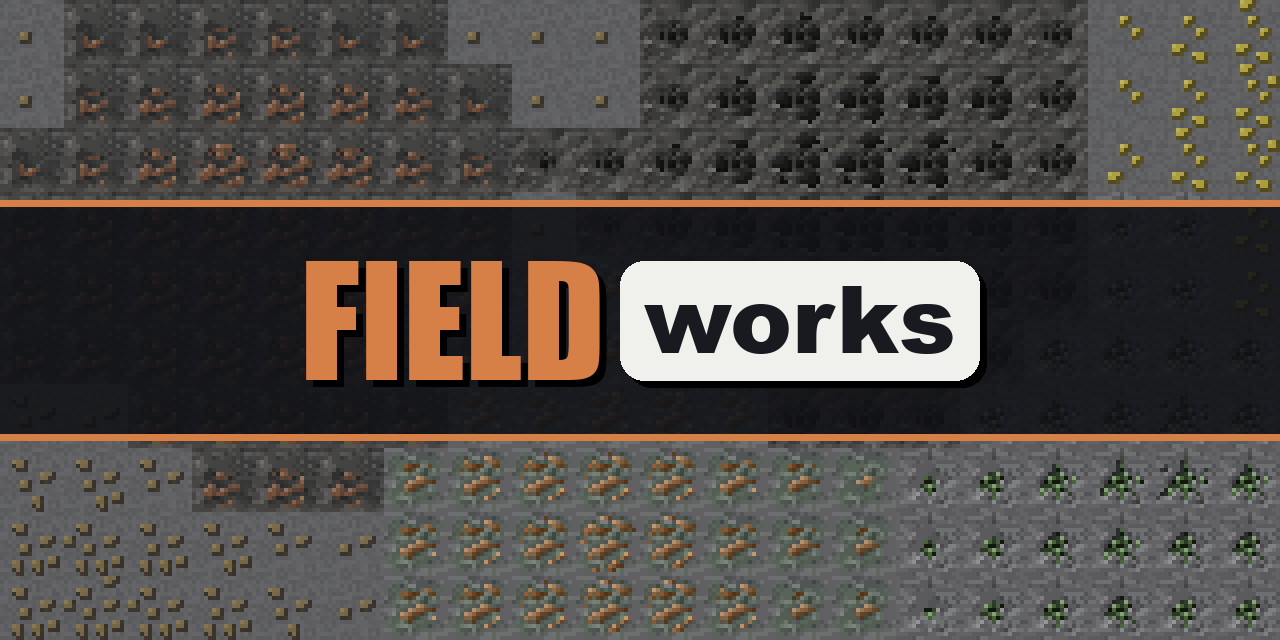
Fieldworks adds a new way to gather resources with less wandering around looking for them. Ore comes in patches that run down as you mine them, and crude oil comes from wells that never run dry. If hand-mining gets tedious, you can craft a Harvester that does all the hard work. Vanilla ore still generates as usual; the patches come on top of it.
I wanted Factorio's ore patches in modded Minecraft.
I also wanted endgame mining that doesn’t mean strip-mining whole chunks. Patches get bigger the further out you go, so when a base needs more ore, you build out to a richer patch. Oil wells never run dry.
NeoForge, Minecraft 26.1.2 only. Fieldworks is still young, so please report anything odd on GitHub.
To play Fieldworks beside every other FactoryWorks mod, install the FactoryWorks Showcase modpack from CurseForge.
Fieldworks carries a gallery of its features: one working scene each, all but the map markers, which need FTB Chunks and a patch the world generated, with a sign naming it, built in a row east of where you stand. It is a datapack in the jar, Fieldworks Gallery, off until you turn it on in a world's Data Packs screen or with /datapack enable "mod/fieldworks:gallery_pack". Then /function fieldworks:gallery/build builds every scene, and /function fieldworks:gallery/<scene> one of them, such as harvester or nether. A function needs cheats in single player (on at world creation, or Open to LAN with cheats) or operator rights on a server. The gallery clears the ground it builds on and changes nothing else; it adds no recipes, loot or worldgen.
fieldworks-common.toml. Turning one off stops new patches; those already generated stay. A world updating to a version with new resources gets their patches only in chunks generated afterwards.fieldworks/ore/amounts.json, read when blocks register: each resource's dimension (overworld or nether), its min_distance in Overworld-equivalent blocks and its amount, density, spot size and edge, and the clearance every patch and oil field keeps from one of another kind (16 blocks). A datapack cannot add a resource or change these.fieldworks:harvesting recipes: a block or block-tag source (or the oil well), a result, a duration, an optional Drilling Fluid with its mB per operation, an optional minimum Harvester tier, and replaces_default, which makes a resource need its recipe. A well's result is {"crude_oil": <mB>}, or {"crude_oil": "cycle"} for the well's own yield; a well's floor is final, so no recipe lifts it. Fieldworks' recipes for uranium, diamond, netherite scrap and the oil well are ordinary written recipes that replace the default, so a datapack overrides them by id: fieldworks:uranium_from_ore, diamond_from_ore, netherite_scrap_from_ore and crude_from_oil_well. The bonus recipes yield at most twice the default; yours are not capped.reach (how many blocks down past the one under it its columns look, 0 when absent, no cap) are in data/fieldworks/harvester_tier/. Their names are in lang.fieldworks:harvestable (default c:ores) is what the Harvester breaks for loot; #fieldworks:drilling_fluids is what a recipe may spend, and holds #fieldworks:drilling_fluids/overworld (drilling mud) and #fieldworks:drilling_fluids/nether (magma slurry), where a pack adds its own fluids to a dimension. The Harvester checks no dimension: which one a recipe wants is the tag it names. #fieldworks:patch_nether (#minecraft:is_nether) and #fieldworks:patch_land are the biomes Patches generate in.fieldworks:crude_oil in c:crude_oil, and any fluid in that tag sets as tar against lava; tar is fieldworks:tar in c:tar. Sulfur is in c:dusts/sulfur and uranium ingots in c:ingots/uranium. The ore blocks are in c:ores and each in c:ores/<resource>, but for stone. Magma slurry is fieldworks:magma_slurry, in no tag a mod reads but Fieldworks' own, and reachable through NeoForge's fluid capability like any bucket.CHANGELOG.md lists what each version changed for a mod building against it.Groundworks is required and is a separate download. FTB Chunks, Jade, EMI and JEI are optional.
The coal, copper, iron, sulfur, uranium, diamond, gold, glowstone and quartz ore sprites (quartz wears his saltpeter), the redstone and netherite ones (his lapis and anthracite turned red and brown), the sulfur, raw uranium and uranium ingot sprites, and the crude oil sprite are by Malcolm Riley (unused-textures), under CC BY 4.0; the cover and icon are drawn from them. The stone and tar sprites are Fieldworks' own. NOTICE and REUSE.toml record each file.
MIT, with the art above under CC BY 4.0. Source is on GitHub.
Project description from CurseForge.
Pick your setup
Choose the version and loader you play, then open the matching release.
Check the dependencies, then try the file in a copied instance before changing a world you care about.
Recent files
fieldworks-0.7.3.jar
11 Nov 2026
fieldworks-0.7.2.jar
6 Nov 2026
fieldworks-0.7.1.jar
4 Nov 2026
fieldworks-0.7.0.jar
30 Oct 2026
fieldworks-0.6.0.jar
25 Oct 2026
fieldworks-0.5.0.jar
24 Oct 2026
fieldworks-0.4.0.jar
23 Oct 2026
fieldworks-0.3.2.jar
23 Oct 2026
fieldworks-0.3.1.jar
23 Oct 2026
fieldworks-0.3.0.jar
23 Oct 2026
fieldworks-0.2.9.jar
20 Oct 2026
fieldworks-0.2.8.jar
20 Oct 2026
Looking for an older file? The official CurseForge project page is in Resources.
 mod
Factorio-style electric poles that power every machine in reach
 mod
Re-Locate is mod that adds new redstone-like Blocks based on Copper and Tuff.
 mod
auto , instant and easy quick Shift + Right-Click: Empty your backpack of all affordable resources and complete bulk trades automatically with one click