German version below · Deutsche Beschreibung weiter unten.
🌍 7 languages, fully translated · 7 Sprachen, vollständig übersetzt: English · Deutsch · Русский · 简体中文 · Español · Português (Brasil) · Français
Every item, machine and screen and the complete in-game handbook · Alle Gegenstände, Maschinen und Fenster und das komplette Handbuch im Spiel
Beta: Tiefbau is in beta. Expect bugs and balance changes, and back up your worlds.
Beta: Tiefbau ist in der Beta. Rechne mit Fehlern und Balance-Änderungen und sichere deine Welten.
Tiefbau – English
Five thousand blocks of real Earth crust under your feet, and the heavy industry to go and get what lies in it.
Tiefbau (German for "civil engineering" and, in mining, "deep mining") deepens the Overworld down to Y −5056 and fills it with strata modelled on real regions: sedimentary basins with salt domes, desert anticlines full of crude oil, ancient gneiss shields and, at the very bottom, a searing zone with magma chambers. Ores no longer come in scattered veins. They sit in rare, huge deposits that you find with a hammer, a geophone and seismic surveys.
Then you go and get them: shaft sinkers and mine hoists, a tunnel boring machine, a bucket-wheel excavator, deep drilling derricks, oil fields and refineries, coal and gas power stations. At the end of the line come an RBMK and a pressurised water reactor, with physics detailed enough to re-enact 1986.
Large plants are not crafted. They are built: the assembly gantry raises them piece by piece in front of you, with crane hook, scaffolding and sparks.
Trailer (2 min, in-game footage, no shaders): watch on YouTube
At a glance
- A world 5,000 blocks deeper: nine geological provinces, real strata, three depth zones, huge caverns and magma chambers
- 20 new ore minerals in rare giant deposits, combined into five composite tiers beyond diamond
- Prospecting with the geologist's hammer, a geophone (384 blocks) and a seismic survey station (up to 4 km)
- Machines that dig for you: shaft sinker, ore drill, deep drilling derrick, 16 × 8 tunnel boring machine, bucket-wheel excavator, hired miners
- The assembly gantry builds every plant larger than 3 × 3, part by part, visibly in 3D
- Crude oil from desert anticlines: oil drilling rigs, a 4,000 mB/t oil derrick, refineries, seven oil products, vehicles
- Electricity (RF/FE): three cable grades, six storage sizes up to 64 GWh, water wheel, coal and combined cycle power stations
- Nuclear power: uranium mining, enrichment cascade, fuel cycle, RBMK-1000 and PWR, radiation, fallout, accidents
- New landscapes: over 120 biomes, planned river networks, high mountain ranges, volcanoes, karst caves, abandoned mines
- Seven languages: English, German, Russian, Simplified Chinese, Spanish, Brazilian Portuguese and French – including an in-game handbook that explains it all
The deep world
The Overworld now ends at Y −5056. The old bedrock at Y −64 is gone; a new bedrock floor lies at the very bottom. Going down, you pass three zones:
- Deep rock (down to −2000): sediments, salt and coal
- Basement rock (down to −4600): gneiss, granulite, gabbro
- Searing zone (below −4600): rock at about 150 °C and magma chambers with lava lakes. Bring fire resistance or a full set of tier III armour.
What lies beneath you depends on the landscape above. There are nine provinces, each modelled on a real region:
- North German Basin under plains and forests
- Arabian oil basin under deserts
- Colorado Plateau under badlands and the red desert
- The Alps under mountains
- Canadian Shield under taiga and snow
- African craton under rainforest and savanna
- Oceanic crust under the sea
- Lignite district under the pine forest (in older worlds under swamps)
- Tropical tower karst under the karst towers (in older worlds under bamboo and sparse jungle)
The strata lie at real heights; at province borders they are uplifted, folded and offset. Below the old caves a network of passages and halls reaches down to Y −1300; deeper down there are no tangled cave systems. Instead you find rare, huge caverns (some with a lake), long open fault fissures and, in the searing zone, magma chambers whose crusts hold rheniite.
Ores are rare, but huge
Scattered veins are gone. Every deposit is a real ore body: banded iron formations, Kiruna-type magnetite, porphyry copper, kimberlite pipes with diamonds, gold-quartz veins, coal seams and salt beds. Twenty new minerals (tungsten, titanium, chromium, cobalt, platinum-group ores, lonsdaleite and more) are of little use on their own. Four of them together make a composite far beyond diamond, and each tier needs the tier before it to mine:
- Cemented carbide: tungsten carbide edges, less damage taken
- Titanium aluminide: lightweight, faster
- Superalloy: heat-proof; a full set protects in the searing zone
- UHT ceramic: pickaxe and shovel break 3 × 3
- Graphene composite: 5 × 5 mining, night vision, Haste II – a key (G) switches area mining off and on
Every rock has a use too: limestone becomes quicklime and cement, marl and clay give concrete, dolomite yields magnesium. Many rocks also hold a little ore that the ore dressing plant washes out.
Prospecting
- Flint hammer: costs no iron. Use it to find your first bog-iron lens, because no iron lies open at the surface.
- Geologist's hammer: names the stratum and depth, and reports ore traces within 40 blocks of a deposit.
- Geophone: hears deposits up to 384 blocks away (direction, distance, depth), the nearest oil trap, and old mine shafts up to 2.5 km.
- Seismic survey station: surveys 2, 3 or 4 km around it and prints a seismic map of every deposit and oil field, with depth bands, filters and waypoints shown as beams of light.
- Field book: logs your finds and keeps your waypoints.
- Miner's helmet: its headlamp switches on by itself underground.
Landscapes and forgotten places
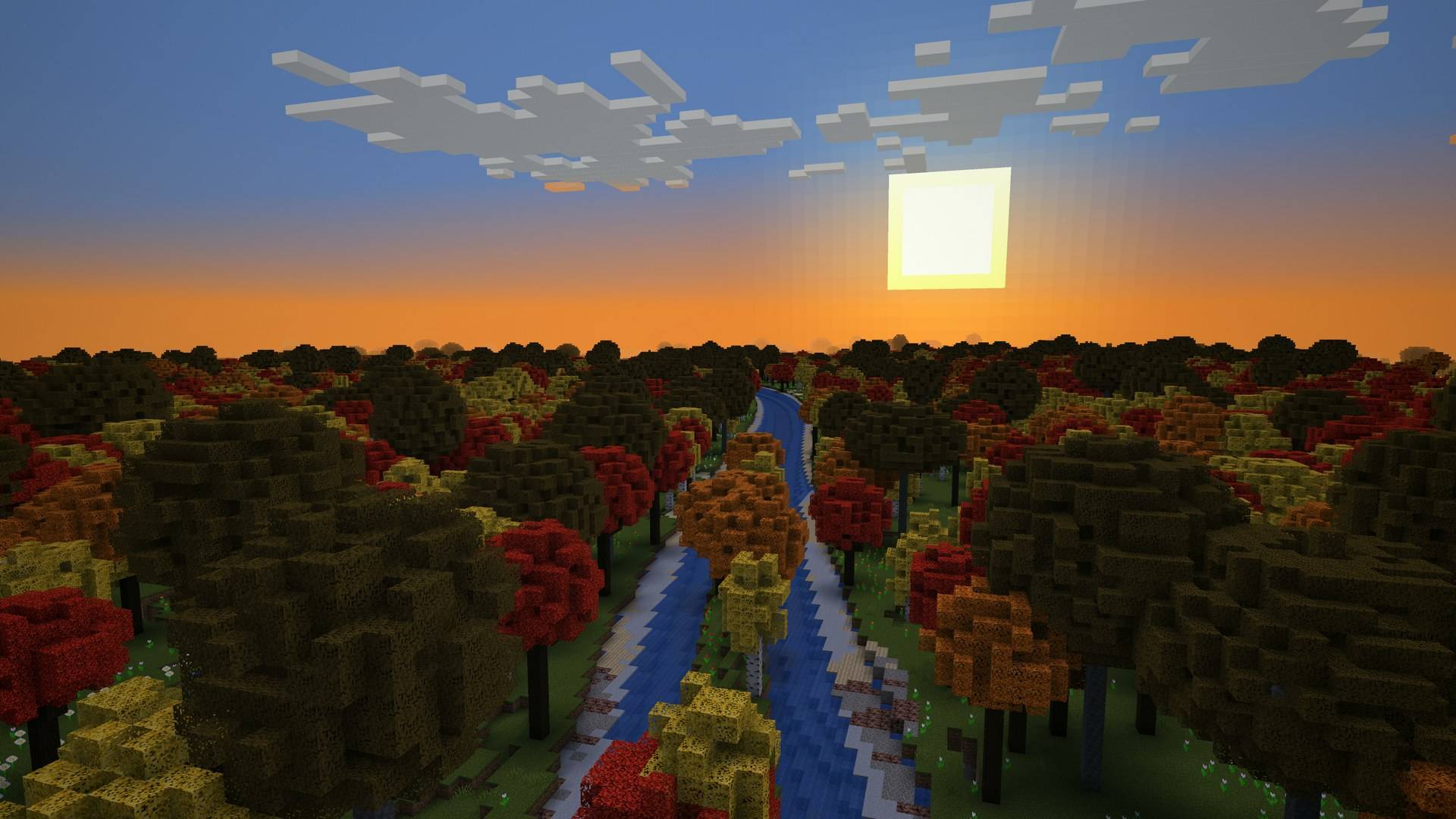
The surface got a makeover too. There are over 120 new biomes modelled on real places, from Alaskan taiga and redwood forests to tepuis, salt flats, the Wadden Sea and rice terraces. Rivers are planned like real drainage: tributaries join into ever wider streams, they meander and cut gorges, and they all find the sea. Placer gold, tin and diamonds wait in the gravel of the inside bends. High mountain ranges with glacial valleys reach up to about Y 800.
Below and between them you'll find karst caves several storeys deep, underground gorges hundreds of blocks long, crystal geode halls, cenotes and giant tiankeng sinkholes, plus climbing ropes, rope clamps and flares to explore them. There are also stratovolcanoes with lava lakes and Eifel-style maar fields.
Across the world lie four abandoned mines (salt, iron, gold, diamond) with headframes, working winding engines and long drifts on every level, and twelve forgotten places such as a colliery, a gold-rush ghost town, a salt cathedral and a meteorite crater.
Mining machines
Most machines are small plants: right-click the ground and the plant goes up with its front facing you. Pipes, cables and belts connect to coloured panels. Pack up puts the machine back in your inventory with its tanks, slots and power intact.
- Shaft sinker: your first way down, long before you have diesel. It digs a 4 × 4 shaft to bedrock on coal, wood or peat and keeps the shaft's chunks loaded.
- Mine hoist: a winding engine, the cage and shaft stations. The cage runs at 40 blocks per second, adjustable up to 120.
- Ore drill: mines every ore block within 16 blocks of it (8 up, 40 down). Its drill head decides which tiers it can cut.
- Deep drilling derrick: drills through the whole crust, logs every deposit within 96 blocks of the borehole and then extracts it through the borehole.
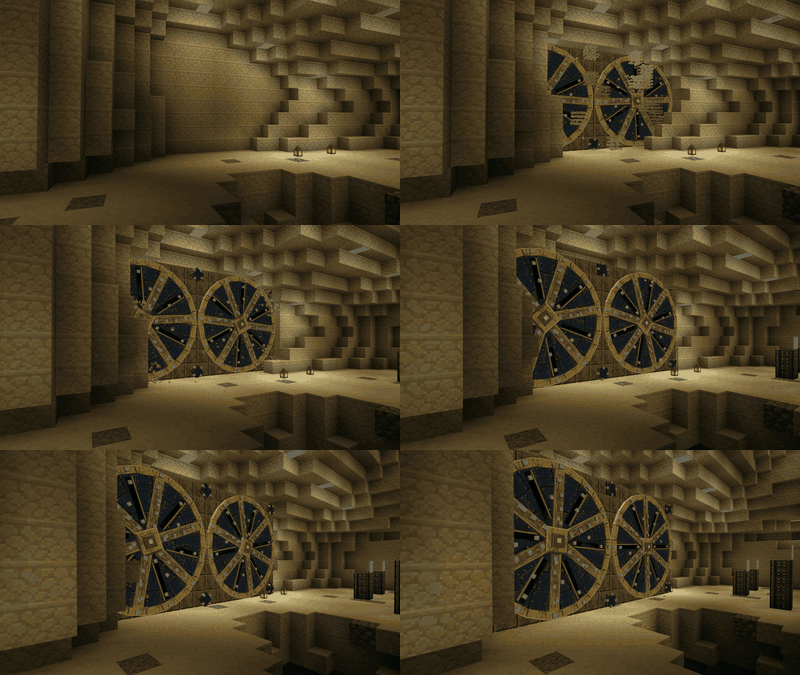
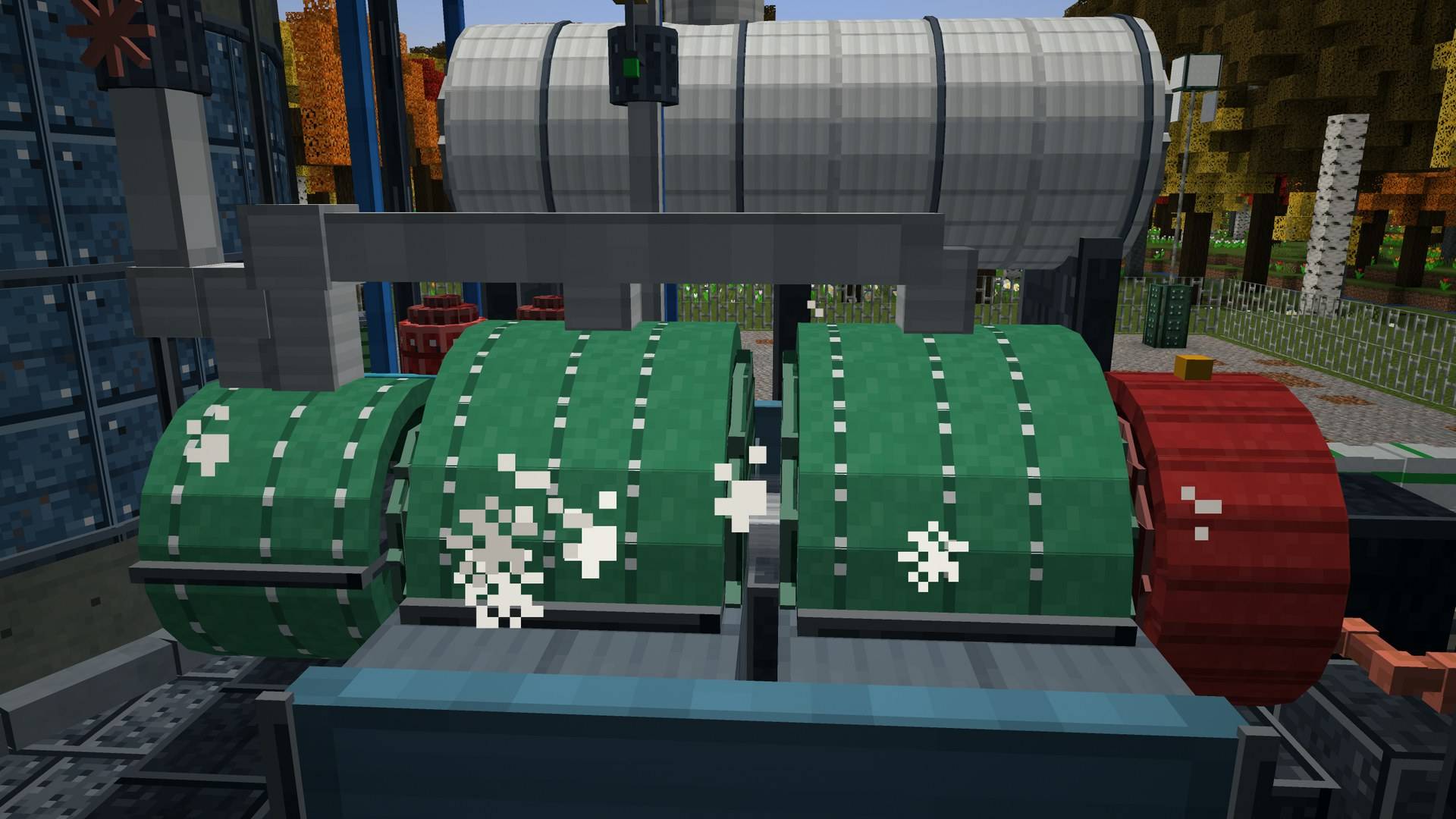
- Tunnel boring machine: twin cutterheads mill a 16 × 8 tunnel. It seals off water, lava and oil with lining segments, hangs up lights and holds a 1,024-bucket fuel tank. You can ride along in its cockpit.
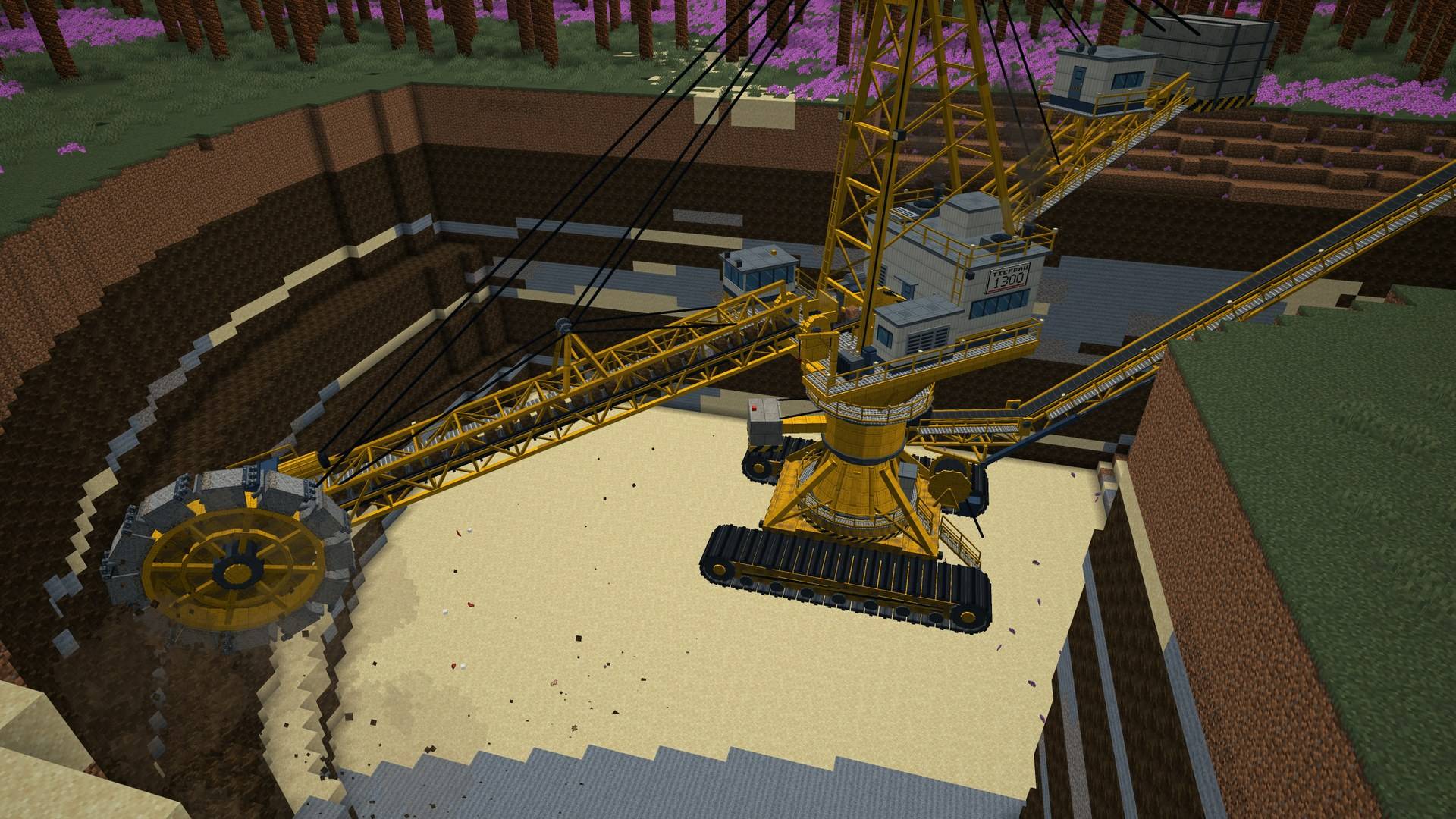
- Bucket-wheel excavator: surveys the whole connected lignite district in front of its transfer station (up to 800 blocks ahead and to either side) and lays lanes 24 blocks apart from one edge of the district to the other, up to 33 of them, to the left or to the right as you choose in its window. It works them lane by lane at 20 to 40 blocks per second, drains and seals the pit and dumps the spoil behind itself. Its field map shows the whole district and the progress (lane and area in per cent).
- Track laying machine: crawls across country, clears a corridor 5 blocks wide and leaves finished rail or road behind it.
- Miners: hire workers who dig out whole veins and fell trees. They are paid in food (a loaf of bread pays for 30 blocks). Up to 16 share a crate, with a reach that grows to 400 blocks.
- Blasting: 17 blasting items, from the black powder squib and dynamite to coyote charges and the ammonium nitrate store, including detonating cord and a blasting machine, plus ANFO from the chemical reactor. The bang arrives at the speed of sound.
Built, not crafted: the assembly gantry
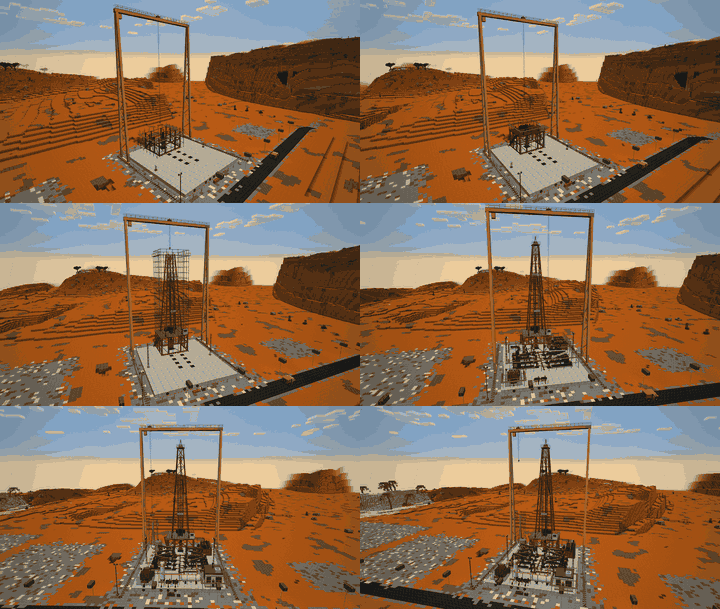
Every machine larger than 3 × 3 is built on a construction site. That includes the large refinery, the oil drilling rig, the deep drilling derrick, the tank farm, the power stations, the greenhouse, the barn, the large dressing plant, the excavator, the tunnel boring machine, the reactors and the larger nuclear fuel plants. Their kits have no crafting recipe. Instead:
- Place the assembly gantry (a site container with its gantry crane); the site lies behind it.
- Pick a project on its desk to see the size, build time, power and materials.
- Fill in the materials by hand, hopper or belt. Pegs and spray paint mark out the site, and obstacles glow red.
- Press Start building. Barrier tape goes up, the crane track is laid and the gantry crane gets to work.
The plant only grows while the crane works on it. The crane fetches a part, travels and lowers it, and the part settles in two to four jolts with sparks, dust or hammer blows.
Construction goes from the bottom up, with scaffolds that stand on solid ground. Each plant needs at most five kinds of material, all craftable. The site draws up to 1,000 RF/t, or burns fuel when there is no power. Aborting refunds everything unused and half of what has already been built in. Finished plants pack up into kits and can be set down elsewhere at once.
Crude oil
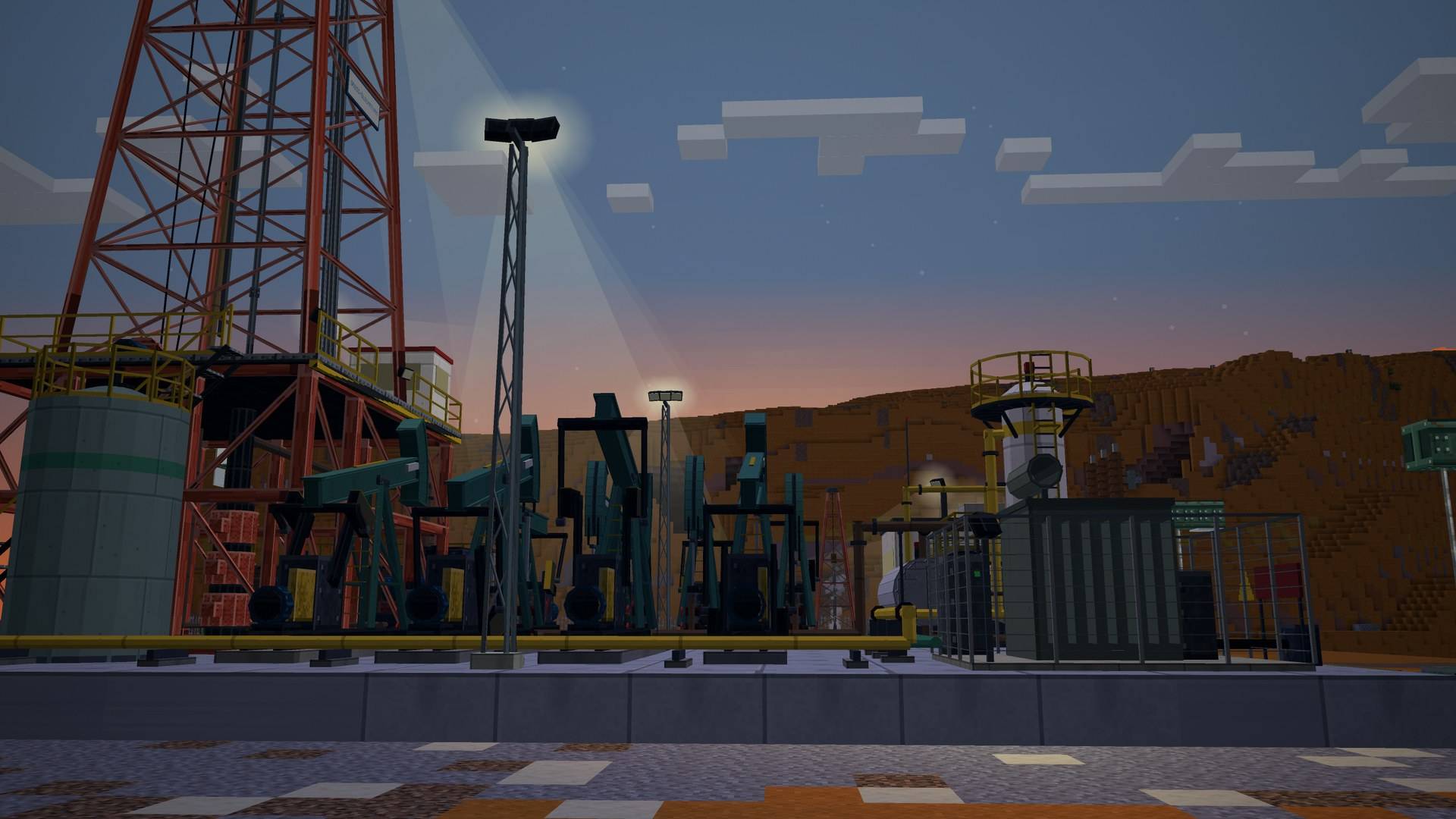
Oil lies under the desert, as in Saudi Arabia's Ghawar field. Porous limestone sealed by anhydrite holds it in three reservoirs, and it gathers only in the crests of anticlines. Every field is finite.
- Oil drilling rig: drills straight down through every stratum, keeps a drilling log and turns into a pumpjack when it hits the reservoir.
- Large oil derrick: a whole 27 × 31 production pad with a 43-block derrick, separators, a flare and water injection. It drills eight deviated wells and lifts 4,000 mB of crude per tick, as much as forty oil drilling rigs.
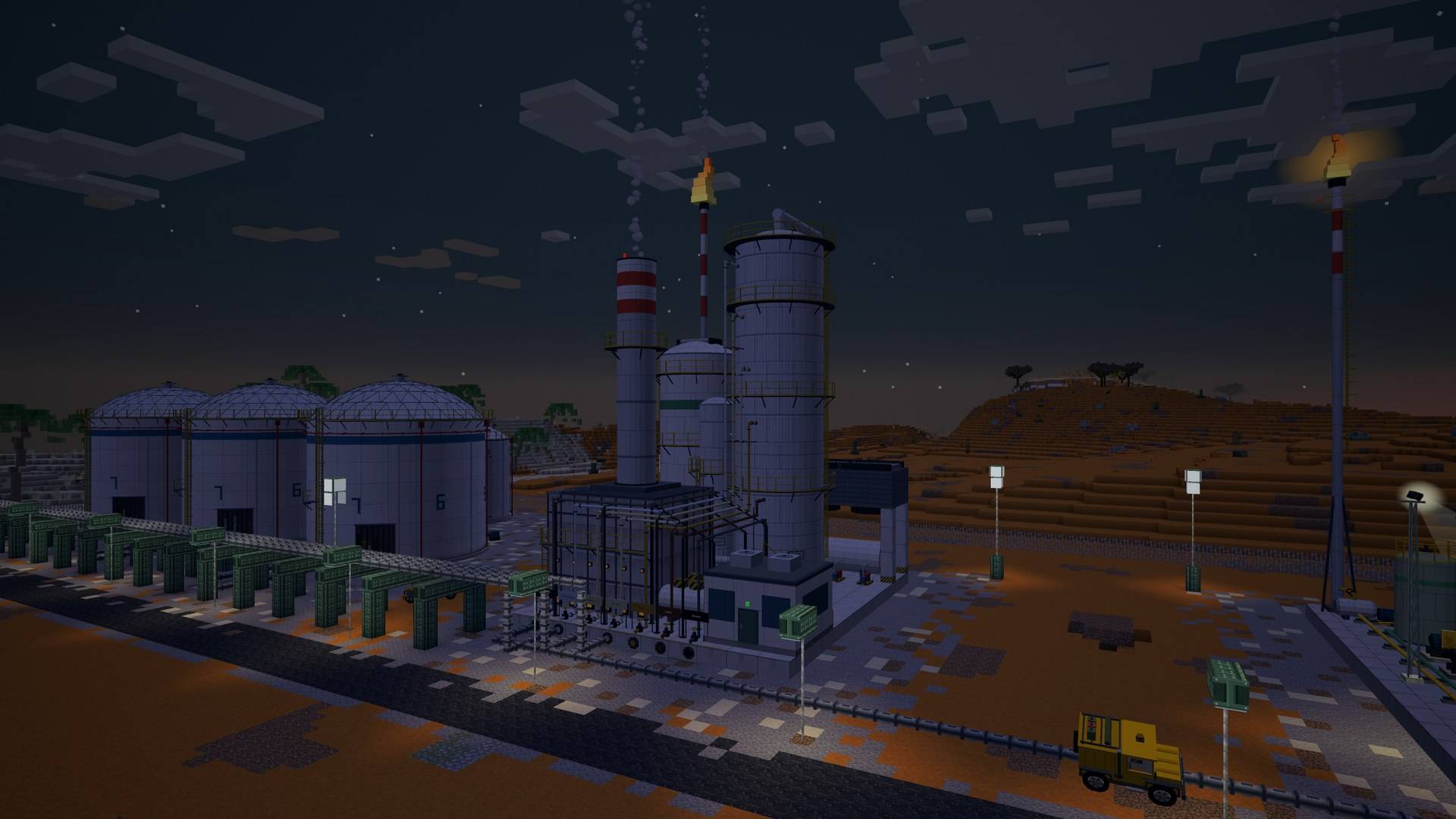
- Refinery (3 × 3, six high) and large refinery (2,000 mB/t, six products at once, fired by its own refinery gas).
- Products: diesel, kerosene, heating oil, refinery gas, naphtha, lubricating oil and bitumen. They feed plastics, asphalt (you walk a third faster on it), tar torches and petroleum coke.
- Storage: pipelines (10,000 mB/t), a 9 × 9 × 9 great tank holding 50,000 buckets, and tank farm kits up to 7 × 250,000 buckets.
- Gear and vehicles: jerrycans, a diesel chainsaw that fells whole trees, an electric drill, a kerosene jetpack, jet elytra, a diesel boat and an off-road truck with a 27-slot load bed.
- Biodiesel: press rapeseed into oil and turn it into diesel with a little refinery gas. It mostly renews itself, but it is costly.
Hoisting, transport and storage
- Conveyor belts in three grades (2, 4 and 8 blocks per second) that carry their load visibly and never lose it, plus belt feeders, diverters, steep belts, inclined belts and a belt drive that keeps long lines running.
- Skip hoist: lifts 27 stacks at a time from the bottom of the shaft at 80 blocks per second.
- Ropeway: cars cross valleys at ten blocks per second, carrying either you or up to nine stacks of ore into the container under the far station.
- Steel storage crate: 104 slots of 32,000 items each; it keeps its contents when broken.
- Central storage terminal: one screen for up to 512 crates on the power network, with autocrafting through production computers, assembly units and pattern cabinets that also drive the mod's machines. JEI "+" transfer is supported.
- Plant radio: one control room keeps up to 16 distant plants loaded and shows their status, with remote stop and start.
Processing and farming
- Ore dressing plant (double yield and by-products), industrial furnace, sinter press, vacuum arc furnace, CVD reactor and chemical reactor
- Large dressing plant with 16 lines, optionally smelting concentrate straight to ingots or pressing steel plates
- Gravel and cement works: turns all the rock your tunnel boring machine brings in into gravel, sand, cement and concrete
- Speed ×1 to ×7 on the processing machines; above ×1 the energy cost rises steeply
- Greenhouse (12 beds, works with crops from other mods), a field machine with its own combine harvester, and a livestock barn with 12 boxes that turns fodder into leather, meat, wool and eggs
Electricity and power stations
Every Tiefbau machine also runs on RF and uses power before fuel. Cables connect to the machines and stores of other mods.
- Cables: copper 2,000 RF/t, medium voltage 20,000 RF/t, high voltage 200,000 RF/t
- Stores: six sizes, from a lead-acid battery bank (4 million RF) and a lithium-ion store to the grid battery (1 GWh = 7.2 billion RF), redox flow (4 GWh), pumped storage (16 GWh) and a 64 GWh superconducting ring
- River water pump: lifts up to 600 mB/t of water for the power stations from a river, lake or the sea
- Run-of-river power station: a water wheel in a real river, 200 to 1,000 RF/t depending on the river's width
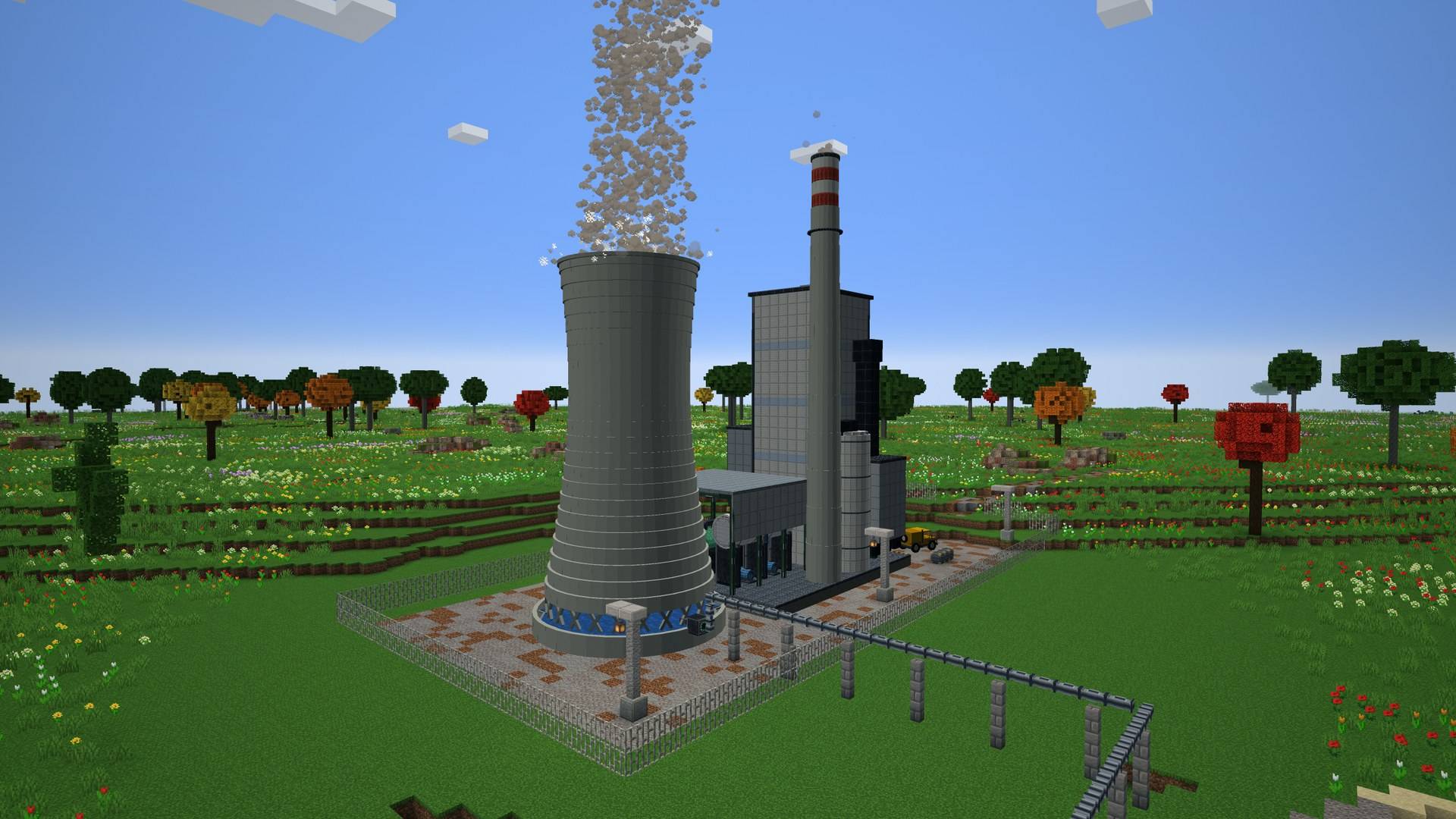
- Coal-fired power station: 600 MW (60,000 RF/t) on a 15 × 35 footprint, with coal bunker, boiler house, turbine hall and cooling tower. A cold start takes about a minute and a half.
- Combined cycle power station: 400 MW (40,000 RF/t) at 58 % efficiency on gas or oil products, ready for the grid in about twenty seconds
- Each station has a control room that shows the whole flow diagram, plus an automatic mode that starts and stops the station with demand
Nuclear power
From ore to fuel
Uranium occurs where it does in reality: pitchblende in the veins of old mountains and shields, and roll-front lenses in sandstone basins. The fuel cycle runs in six plants: leaching to yellowcake, conversion to UF₆, a gas-centrifuge cascade, then pellets, zircaloy-clad rods, RBMK cassettes and 18 × 18 PWR assemblies. Afterwards come PUREX reprocessing, MOX fuel and vitrification into glass canisters.
As in reality, one centrifuge separates next to nothing. A cascade of n centrifuges runs at n² / (n² + 600²) of full speed, so 64 centrifuges need more than a day per cylinder and 4,096 need twenty seconds.
RBMK-1000
A whole power unit as one machine, rated at 3,200 MW thermal: graphite core, refuelling machine, drum separators, eight main circulation pumps and the turbine set. Its turbine condensers are cooled with river water from intake pumps. It is controlled from a full control room with four rod groups, just like the real plant:
- AZ: emergency protection rods
- RR: manual rods
- AR: automatic regulators
- USP: shortened absorbers, inserted from below
Under the hood: six groups of delayed neutrons, a positive void coefficient, xenon-135 poisoning with a real xenon pit, the operational reactivity margin (ORM), graphite displacers on the rods, an alarm panel that records the first-out order, and a reactor process computer that can start the plant for you.
Refuelling under load, as the real RBMK was built for: the refuelling machine exchanges a channel group channel by channel while the reactor runs, and pauses whenever the power leaves its band or the period gets short. It keeps the spent assembly cooled and carries it to a free rack in the spent fuel pool.
Follow the rules and the reactor is safe. Bridge the ORM lock, pull the rods out of a xenon-poisoned core and press AZ-5, and the handbook's 1986 timetable plays out to the end. A modernisation kit retrofits the lessons of 1986: afterwards AZ-5 shuts the reactor down without a power peak.
Pressurised water reactor
A Konvoi-type PWR (3,850 MW thermal, 155 bar) with four coolant loops, pressuriser, emergency cooling and containment. It is controlled with boric acid and the control rod bank. Hotter water lowers the power by itself, so this reactor cannot run away. Its danger is losing coolant: core melt, hydrogen and a failing containment.
Accidents, radiation and fallout
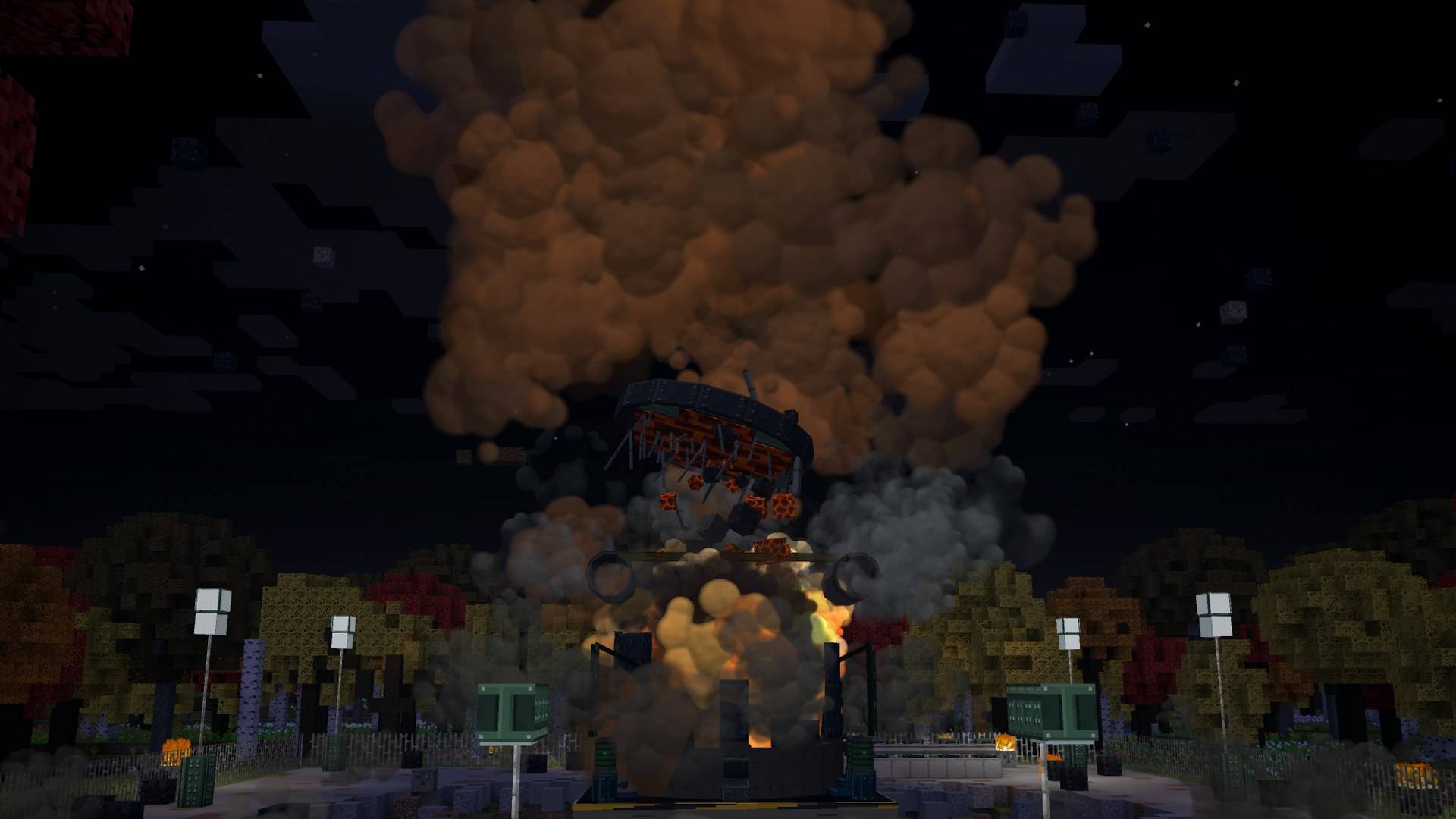
- An exploded RBMK leaves a burning graphite fire that will not go out by itself. Smother it with sand or boron carbide drop sacks, then enclose the ruin in a sarcophagus.
- Radiation is dust, not a magic zone. Iodine-131, caesium-137, strontium-90 and hot particles are carried by the wind, washed out of the air by rain, moved by rivers and tracked around on boots and fur. Trees die and turn red.
- Accidents deep underground stay underground: under more than 16 blocks of rock the dust settles in the cavity. Only if a shaft or drift leads to the sky does part of it escape, from that opening alone and thinned out by the length and width of the way.
- Gamma and neutron radiation with real shielding: lead, concrete, water and borated polyethylene.
- Dose and radiation sickness for players, animals and monsters alike.
- Tools to deal with it: Geiger counter, contamination monitor, dosimeter, false-colour radiation goggles, protective suit with filter, decontamination shower, potassium iodide, Prussian blue and filgrastim.
- The spent fuel chain: pool racks with Cherenkov glow, pool cooler, transfer flask and a CASTOR cask with the real sealing steps.
Explosions, the Red Forest, fallout reach and more can all be tuned in the config (see the FAQ).
Getting started
- Craft a flint hammer (stick, 2 flint, leather) and knock on the ground every hundred blocks or so under plains and swamps until it reports ore traces. That is your first bog iron.
- Craft the Handbook of Deep Mining (book + raw iron). It explains everything in this description, with an ore guide for every biome.
- Craft the geologist's hammer (iron, a stick and leather) and later the geophone (a compass and a diamond or amethyst shard, or the hammer with 3 iron ingots and leather) to locate real deposits.
- Build a shaft sinker (iron ingots, an iron pickaxe, a furnace and a chest) to get down, and a winding engine to get back up.
- Make steel plates in the sinter press, then an ore dressing plant and your first composite tier.
- Build the assembly gantry and let it raise your first oil drilling rig over a desert anticline. From there on: refinery, power, and eventually the reactor.
JEI shows every recipe, deposit and construction project, and the handbook has a chapter for each step.
Requirements and compatibility
| Requirement |
Version |
| Minecraft |
1.21.1 |
| NeoForge |
21.1.213 or newer |
| Java |
21 |
| Install on |
client and server |
| JEI |
optional (recommended) |
- Power: Tiefbau cables connect to any mod that uses RF/FE.
- Ores of other mods (Mekanism, Create, Immersive Engineering, All the Ores and others, via the "c:ores" tags) are placed as geological deposits instead of scattered veins. This can be switched off in config/tiefbau-common.toml.
- Existing worlds: chunks saved before installing get the deep part added when they load. Worlds created before installing keep the old province rule by default (option provinces in config/tiefbau-common.toml). New landscapes only appear in chunks created after installing. Make a backup first.
- World border: to make room for 5,000 more blocks of height, block positions are packed differently. The world therefore ends at X/Z ±8,000,000 instead of ±30,000,000. Mods that depend on vanilla's exact position packing may conflict; please report anything you find.
FAQ
Do I need to start a new world?
No, but it is recommended. Old chunks get the deep world underneath them, while the new surface landscapes, rivers and volcanoes appear only in terrain that is new.
Where are the ores? I can't find any iron!
That is deliberate: there is no iron lying around at the surface. Craft the flint hammer and search under plains and swamps for bog iron. Magnetite sand in river beds also gives iron nuggets.
Can I turn off reactor explosions or the dying forest?
Yes. In config/kernkraft-common.toml (comments in English and German): reaktorexplosionen (reactor explosions), waldsterben (Red Forest), fallout_reichweite (fallout reach in blocks), staub_wind / staub_regen (dust carried by wind and rain), ruine_unzerstoerbar (indestructible ruin) and strahlung_wirkt_auf_lebewesen (radiation affects animals and monsters).
Can I re-enact the 1986 accident on purpose?
Yes. The handbook has a step-by-step timetable for it, as well as three rules that reliably prevent it.
Does it work with other tech mods?
Power is plain RF/FE, so other mods' cables, power sources and machines connect. Other mods' ores become part of the geology.
Is JEI required?
No. With JEI installed you get categories for deposits, machine recipes, the refinery, oil wells, the ore drill, fuels and construction projects.
Are the screenshots made with shaders?
No. All pictures and the trailer use vanilla rendering, with only a light colour grade.
Status and roadmap
Tiefbau is in beta and under active development. The current version is listed under Files. Expect bugs and balance changes, and back up your worlds. Please report bugs and send balancing feedback in the comments. Next steps depend on what players run into, so tell me what you'd like to see.
Some things are deliberately simplified: the PWR core has 37 instead of 193 assemblies, xenon builds up 120 times faster than in reality, and a rod equivalent is worth more than in the real RBMK. The handbook's chapter Reality and Game lists every deviation.
Credits
- Design and code: Niklas
- Built on NeoForge with Parchment mappings; recipe viewer integration for JEI
- Inspired by real places and machines: Ghawar, Kiruna, Wieliczka, the Big Hole, Rhenish lignite mining and the RBMK-1000 and Konvoi reactors
Glück auf! (the German miners' greeting)
Tiefbau – Deutsch
Fünftausend Blöcke echte Erdkruste unter deinen Füßen – und die Schwerindustrie, um herauszuholen, was darin steckt.
Tiefbau vertieft die Oberwelt bis Y −5056 und füllt sie mit Gesteinsschichten nach echten Vorbildern: Sedimentbecken mit Salzstöcken, Wüstensättel voller Erdöl, uralte Gneisschilde und ganz unten eine Glutzone mit Magmakammern. Erze gibt es nicht mehr als verstreute Adern, sondern nur noch in seltenen, riesigen Lagerstätten, die du mit Hammer, Geophon und Seismik aufspürst.
Dann holst du sie dir: mit Abteufmaschine und Fördermaschine, Tunnelbohrmaschine, Schaufelradbagger und Tiefbohrturm, mit Ölfeldern und Raffinerien, Kohle- und Gaskraftwerken. Am Ende der Kette stehen ein RBMK und ein Druckwasserreaktor, deren Physik genau genug ist, um 1986 nachzustellen.
Großanlagen werden nicht in der Werkbank hergestellt, sondern gebaut: Das Montageportal errichtet sie Teil für Teil vor deinen Augen, mit Kranhaken, Gerüst und Funkenflug.
Trailer (2 Min., Spielaufnahmen ohne Shader): auf YouTube ansehen. Weitere Bilder im englischen Teil oben.
Auf einen Blick
- Eine Welt, 5.000 Blöcke tiefer: neun geologische Provinzen, echte Schichtenfolgen, drei Tiefenzonen, riesige Kavernen und Magmakammern
- 20 neue Erzminerale in seltenen Riesenlagerstätten, kombiniert zu fünf Verbundstoff-Stufen jenseits von Diamant
- Prospektion mit Geologenhammer, Geophon (384 Blöcke) und Seismikstation (bis 4 km)
- Maschinen, die für dich graben: Abteufmaschine, Erzbohrer, Tiefbohrturm, Tunnelbohrmaschine (16 × 8), Schaufelradbagger, angeworbene Bergarbeiter
- Das Montageportal baut jede Anlage, die größer als 3 × 3 ist, Teil für Teil und sichtbar in 3D
- Erdöl aus Wüstensätteln: Ölbohranlagen, ein Groß-Ölbohrturm mit 4.000 mB/t, Raffinerien, sieben Ölprodukte, Fahrzeuge
- Strom (RF/FE): drei Kabelstufen, sechs Speichergrößen bis 64 GWh, Wasserrad, Steinkohle- und GuD-Kraftwerk
- Kernkraft: Uranbergbau, Anreicherungskaskade, Brennstoffkreislauf, RBMK-1000 und Druckwasserreaktor, Strahlung, Fallout, Unfälle
- Neue Landschaften: über 120 Biome, geplante Flusssysteme, Hochgebirge, Vulkane, Karsthöhlen, verlassene Bergwerke
- Sieben Sprachen: Deutsch, Englisch, Russisch, Chinesisch (vereinfacht), Spanisch, Portugiesisch (Brasilien) und Französisch – samt Handbuch im Spiel, das alles erklärt
Die Tiefe
Die Oberwelt reicht jetzt bis Y −5056. Das alte Grundgestein bei Y −64 ist verschwunden, ein neuer Boden aus Grundgestein liegt ganz unten. Auf dem Weg nach unten durchquerst du drei Zonen:
- Tiefengestein (bis −2000): Sedimente, Salz und Kohle
- Urgestein (bis −4600): Gneis, Granulit, Gabbro
- Glutzone (unter −4600): rund 150 °C heißes Gestein und Magmakammern mit Lavaseen. Ohne Feuerresistenz oder einen vollen Rüstungssatz der Stufe III verbrennst du.
Was unter dir liegt, hängt von der Landschaft darüber ab. Es gibt neun Provinzen nach echten Vorbildern:
- Norddeutsches Becken unter Ebenen und Wäldern
- Arabisches Ölbecken unter Wüsten
- Colorado-Plateau unter Badlands und roter Wüste
- Alpen unter Gebirgen
- Kanadischer Schild unter Taiga und Schnee
- Afrikanischer Kraton unter Regenwald und Savanne
- Ozeankruste unter dem Meer
- Braunkohlerevier unter dem Kiefernforst (in älteren Welten unter Sümpfen)
- Tropischer Kegelkarst unter den Karsttürmen (in älteren Welten unter Bambus- und lichtem Dschungel)
Die Schichten liegen in echten Höhen; an den Provinzgrenzen sind sie gehoben, gefaltet und versetzt. Unter den alten Höhlen reicht ein Netz aus Gängen und Hallen bis Y −1300; noch tiefer gibt es keine verschlungenen Höhlensysteme, sondern seltene Riesenkavernen (manche mit See), lange offene Klüfte und in der Glutzone Magmakammern, in deren Krusten Rheniit wächst.
Erze: selten, aber riesig
Verstreute Adern gibt es nicht mehr. Jede Lagerstätte ist ein echter Erzkörper: Bändereisenerz, Magnetit wie in Kiruna, Porphyrkupfer, Kimberlitschlote mit Diamanten, Goldquarzgänge, Kohleflöze und Salzlager. Zwanzig neue Minerale (Wolfram, Titan, Chrom, Kobalt, Platinmetalle, Lonsdaleit und mehr) taugen allein wenig. Vier davon zusammen ergeben einen Verbundstoff weit jenseits von Diamant, und jede Stufe braucht zum Abbau die vorige:
- Hartmetall: Wolframkarbid-Schneiden, weniger Schaden
- Titanaluminid: leicht und schneller
- Superlegierung: hitzefest; ein voller Satz schützt in der Glutzone
- UHT-Keramik: Spitzhacke und Schaufel bauen 3 × 3 ab
- Graphenverbund: 5 × 5 Abbau, Nachtsicht, Eile II – eine Taste (G) schaltet den Flächenabbau aus und an
Auch jedes Gestein hat seinen Nutzen: Kalkstein wird zu Branntkalk und Zement, Mergel und Ton geben Beton, Dolomit liefert Magnesium. Viele Gesteine enthalten etwas Erz, das die Aufbereitungsanlage auswäscht.
Prospektion
- Feuersteinhammer: kostet kein Eisen. Damit findest du die erste Raseneisenstein-Linse, denn offen an der Oberfläche liegt kein Eisen.
- Geologenhammer: nennt Schicht und Tiefe und meldet Erzspuren bis 40 Blöcke um eine Lagerstätte.
- Geophon: hört Lagerstätten bis 384 Blöcke weit (Richtung, Entfernung, Tiefe), die nächste Ölfalle und alte Schächte bis 2,5 km.
- Seismikstation: vermisst 2, 3 oder 4 km im Umkreis und druckt eine Seismikkarte aller Lagerstätten und Ölfelder, mit Tiefenbändern, Filtern und Wegpunkten als Lichtstrahl.
- Feldbuch: verzeichnet deine Funde und Wegpunkte.
- Grubenhelm mit Kopflampe: Die Lampe schaltet sich unter Tage von selbst ein.
Landschaften und Lost Places
Auch die Oberfläche ist neu: über 120 Biome nach echten Vorbildern, von der Alaska-Taiga und Mammutbaumwäldern bis zu Tepuis, Salzpfannen, Wattenmeer und Reisterrassen. Flüsse sind geplant wie echte Gewässernetze: Nebenflüsse vereinen sich zu immer breiteren Strömen, sie mäandrieren, schneiden Schluchten und finden alle ins Meer. In den Innenkurven warten Seifengold, Zinn und Diamanten im Kies. Hochgebirge mit Trogtälern reichen bis etwa Y 800.
Darunter und dazwischen liegen mehrstöckige Karsthöhlen, Hunderte Blöcke lange unterirdische Schluchten, Kristallgeoden, Cenoten und riesige Tiankeng-Einsturztrichter – dazu Kletterseile, Seilklemmen und Leuchtpatronen, um sie zu erkunden. Außerdem gibt es Schichtvulkane mit Lavaseen und Maarfelder wie in der Eifel.
Über die Welt verteilt liegen vier stillgelegte Bergwerke (Salz, Eisen, Gold, Diamant) mit Fördergerüst, betriebsbereiter Fördermaschine und langen Strecken auf jeder Sohle sowie zwölf Lost Places, etwa eine Zeche, eine Goldgräberstadt, eine Salzkathedrale und ein Meteoritenkrater.
Bergbaumaschinen
Die meisten Maschinen sind kleine Anlagen: Rechtsklick auf den Boden, und die Anlage steht mit der Front zu dir. Rohre, Kabel und Bänder kommen an farbige Anschlussfelder. Einpacken legt die Maschine mit Tanks, Fächern und Strom zurück ins Inventar.
- Abteufmaschine: dein erster Weg nach unten, lange bevor du Diesel hast. Sie teuft einen 4 × 4-Schacht bis zum Grundgestein ab, brennt Kohle, Holz oder Torf und hält die Chunks des Schachts geladen.
- Grubenaufzug: Fördermaschine, Förderkorb und Schachtstationen. Der Korb fährt 40 Blöcke pro Sekunde, einstellbar bis 120.
- Erzbohrer: baut jeden Erzblock im Umkreis von 16 Blöcken ab (8 nach oben, 40 nach unten). Die Bohrkrone bestimmt, welche Stufen er schafft.
- Tiefbohrturm: bohrt durch die ganze Kruste, verzeichnet jede Lagerstätte bis 96 Blöcke um das Bohrloch und fördert sie dann durch das Bohrloch.
- Tunnelbohrmaschine: Zwei Schneidräder fräsen einen Tunnel von 16 × 8 Blöcken. Wasser, Lava und Öl dichtet sie mit Tübbingsegmenten ab, sie hängt Lampen auf und hat einen Tank für 1.024 Eimer. Im Fahrerstand fährst du mit.
- Schaufelradbagger: vermisst das ganze zusammenhängende Braunkohlerevier vor seiner Übergabeanlage (bis 800 Blöcke nach vorn und zu beiden Seiten) und legt Bahnen im Abstand von 24 Blöcken von einem Rand des Reviers zum anderen, höchstens 33, nach links oder rechts – die Abbaurichtung wählst du im Fenster. Er fährt sie Bahn für Bahn mit 20 bis 40 Blöcken pro Sekunde ab, entwässert und dichtet die Grube und kippt den Abraum hinter sich. Die Feldkarte zeigt das ganze Revier und den Fortschritt (Bahn und Fläche in Prozent).
- Streckenbaumaschine: kriecht übers Land, räumt eine 5 Blöcke breite Trasse und hinterlässt fertige Gleise oder Straße.
- Bergarbeiter: Angeworbene Arbeiter bauen ganze Adern ab und fällen Bäume. Bezahlt wird im Gedinge mit Essen (ein Brot reicht für 30 Blöcke). Bis zu 16 teilen sich eine Kiste, ihre Reichweite wächst bis 400 Blöcke.
- Sprengtechnik: 17 Sprengmittel vom Schwarzpulver-Böller und Dynamit bis zu Kammerladung und Ammoniumnitrat-Großlager, mit Sprengschnur und Zündmaschine, dazu ANFO aus dem Chemiereaktor. Der Knall kommt mit Schallgeschwindigkeit.
Gebaut, nicht gecraftet: das Montageportal
Jede Maschine, die größer als 3 × 3 ist, entsteht auf einer Baustelle: unter anderem Großraffinerie, Ölbohranlage, Tiefbohrturm, Tanklager, Kraftwerke, Gewächshaus, Viehstall, Großaufbereitung, Schaufelradbagger, Tunnelbohrmaschine, die Reaktoren und die größeren Anlagen des Brennstoffkreislaufs. Ihre Bausätze haben kein Werkbankrezept. Stattdessen:
- Stell das Montageportal auf (einen Baustellencontainer mit Portalkran); die Baustelle liegt dahinter.
- Wähle am Pult ein Vorhaben – du siehst Größe, Bauzeit, Strom und Material.
- Fülle das Material ein, von Hand, per Trichter oder Band. Pflöcke und Sprühfarbe stecken die Baustelle ab, Hindernisse leuchten rot.
- Drück Bau beginnen: Absperrband, Kranbahn, und der Portalkran legt los.
Die Anlage wächst nur, während der Kran an ihr arbeitet: Er holt ein Teil, fährt hinüber und senkt es ab, und das Teil setzt sich in zwei bis vier Rucken mit Funken, Staub oder Hammerschlägen.
Gebaut wird von unten nach oben, Gerüste stehen auf festem Grund. Jede Anlage braucht höchstens fünf Materialarten, alle herstellbar. Die Baustelle zieht bis 1.000 RF/t oder verbrennt ohne Strom Brennstoff. Wer abbricht, bekommt Ungenutztes ganz und schon Verbautes zur Hälfte zurück. Fertige Anlagen lassen sich als Bausatz einpacken und sofort woanders aufstellen.
Erdöl
Öl liegt unter der Wüste wie im saudischen Ghawar-Feld: In porösem Kalkstein unter dichtem Anhydrit, in drei Speicherhorizonten, und nur im Scheitel von Sätteln. Jedes Feld ist endlich.
- Ölbohranlage: bohrt senkrecht durch alle Schichten, führt ein Bohrprotokoll und wird zur Pferdekopfpumpe, sobald sie den Speicher trifft.
- Groß-Ölbohrturm: ein ganzer Förderplatz von 27 × 31 Blöcken mit 43 Blöcke hohem Bohrturm, Separatoren, Fackel und Wasserinjektion. Er bohrt acht abgelenkte Bohrungen und fördert 4.000 mB Rohöl pro Tick – so viel wie vierzig Ölbohranlagen.
- Raffinerie (3 × 3, sechs hoch) und Großraffinerie (2.000 mB/t, sechs Produkte zugleich, beheizt mit eigenem Raffineriegas).
- Produkte: Diesel, Kerosin, Heizöl, Raffineriegas, Naphtha, Schmieröl und Bitumen – für Kunststoff, Asphalt (darauf läufst du ein Drittel schneller), Teerfackeln und Petrolkoks.
- Lagerung: Rohrleitungen (10.000 mB/t), ein frei gemauerter Großtank aus Tankwänden (bis 9 × 9 × 9, 50.000 Eimer) und Tanklager-Bausätze bis 7 × 250.000 Eimer.
- Ausrüstung und Fahrzeuge: Kanister, eine Diesel-Kettensäge, die ganze Bäume fällt, Elektrobohrer, Kerosin-Düsenrucksack, Düsen-Elytra, Dieselboot und ein Geländewagen mit 27 Ladeplätzen.
- Biodiesel: Raps zu Öl pressen und mit etwas Raffineriegas zu Diesel umestern – weitgehend nachwachsend, aber aufwendig.
Förderung, Transport und Lager
- Förderbänder in drei Stufen (2, 4 und 8 Blöcke pro Sekunde), die ihre Ladung sichtbar tragen und nie verlieren, dazu Bandaufgabe, Bandweiche, Steilförderer, Schrägband und Bandantrieb für lange Strecken.
- Skipförderung: hebt 27 Stapel auf einmal mit 80 Blöcken pro Sekunde vom Skip-Füllort am Schachtgrund nach oben.
- Seilbahn: Gondeln überqueren Täler mit zehn Blöcken pro Sekunde und tragen entweder dich oder bis zu neun Stapel Erz in den Behälter unter der Gegenstation.
- Stahl-Lagerkiste: 104 Fächer mit je 32.000 Gegenständen; behält ihren Inhalt beim Abbauen.
- Zentrallager-Terminal: ein Bildschirm für bis zu 512 Kisten am Stromnetz, mit Autocrafting über Fertigungsrechner, Montageeinheiten und Musterschränke, die auch die Maschinen der Mod bedienen. JEI-„+“-Übernahme wird unterstützt.
- Werksfunk: ein Leitstand hält bis zu 16 entfernte Anlagen geladen, zeigt ihren Zustand und stoppt oder startet sie aus der Ferne.
Verarbeitung und Landwirtschaft
- Aufbereitungsanlage (doppelte Ausbeute und Nebenprodukte), Industrieofen, Sinterpresse, Vakuum-Lichtbogenofen, CVD-Reaktor und Chemiereaktor
- Großaufbereitung mit 16 Linien, wahlweise mit Schmelze direkt zu Barren oder als Stahlplatten-Linie
- Schotter- und Zementwerk: macht aus dem Gestein der Tunnelbohrmaschine Schotter, Sand, Zement und Beton
- Tempo ×1 bis ×7 an den Verarbeitungsmaschinen; über ×1 steigt der Energiebedarf steil
- Gewächshaus (12 Beete, auch für Pflanzen anderer Mods), Feldmaschine mit eigenem Mähdrescher und Viehstall mit 12 Boxen, der aus Futter Leder, Fleisch, Wolle und Eier macht
Strom und Kraftwerke
Jede Tiefbau-Maschine läuft auch mit RF und nutzt Strom vor Brennstoff. Die Kabel verbinden sich mit Maschinen und Speichern anderer Mods.
- Kabel: Kupferkabel 2.000 RF/t, Mittelspannung 20.000 RF/t, Hochspannung 200.000 RF/t
- Speicher: sechs Größen, von der Blei-Akkubank (4 Mio. RF) und dem Lithium-Ionen-Speicher über den Batterie-Großspeicher (1 GWh = 7,2 Mrd. RF), Redox-Flow (4 GWh) und Pumpspeicherwerk (16 GWh) bis zum supraleitenden Ringspeicher mit 64 GWh
- Flusswasserpumpe: hebt bis 600 mB/t Wasser für die Kraftwerke aus Fluss, See oder Meer
- Laufwasserkraftwerk: ein Wasserrad im echten Fluss, 200 bis 1.000 RF/t je nach Flussbreite
- Steinkohlekraftwerk: 600 MW (60.000 RF/t) auf 15 × 35 Blöcken mit Kohlebunker, Kesselhaus, Maschinenhaus und Kühlturm. Ein Kaltstart dauert etwa anderthalb Minuten.
- Gas- und Dampfkraftwerk: 400 MW (40.000 RF/t) bei 58 % Wirkungsgrad mit Gas oder Ölprodukten, nach rund zwanzig Sekunden am Netz
- Jedes Kraftwerk hat einen Leitstand mit dem ganzen Fließbild und einen Automatikbetrieb, der es nach Bedarf an- und abfährt
Kernkraft
Vom Erz zum Brennelement
Uran liegt dort, wo es auch in Wirklichkeit liegt: als Pechblende in Gängen alter Gebirge und Schilde und als Rollfront-Linsen in Sandsteinbecken. Der Brennstoffkreislauf läuft über sechs Anlagen: Laugung zu Yellowcake, Konversion zu UF₆, eine Gaszentrifugen-Kaskade, dann Pellets, Brennstäbe in Zirkaloy-Hüllrohren, RBMK-Brennelementkassetten und DWR-Brennelemente (18 × 18). Danach folgen Wiederaufarbeitung (PUREX), MOX-Brennstoff und Verglasung zu HAW-Glaskokillen.
Wie in Wirklichkeit trennt eine einzelne Zentrifuge fast nichts. Eine Kaskade aus n Zentrifugen arbeitet mit n² / (n² + 600²) der vollen Geschwindigkeit: 64 Zentrifugen brauchen mehr als einen Tag für einen Zylinder, 4.096 nur zwanzig Sekunden.
RBMK-1000
Ein ganzer Kraftwerksblock als eine Maschine mit 3.200 MW thermischer Leistung: Graphitkern, Lademaschine, Trommelabscheider, acht Hauptumwälzpumpen und Turbosatz. Die Kondensatoren kühlt Flusswasser aus Flusswasser-Einlaufpumpen. Gesteuert wird er aus einer vollständigen Blockwarte mit vier Stabgruppen wie im echten Kraftwerk:
- AZ: Notschutz-Stäbe
- RR: Handstäbe
- AR: automatische Regelstäbe
- USP: verkürzte Absorber, von unten eingefahren
Unter der Haube: sechs Gruppen verzögerter Neutronen, ein positiver Dampfblasenkoeffizient, Xenon-135-Vergiftung mit echter Xenon-Grube, die operative Reaktivitätsreserve (ORM), Graphitverdränger an den Stäben, eine Meldetafel, die sich die Reihenfolge der Meldungen merkt, und ein Reaktor-Prozessrechner, der die Anlage für dich anfährt.
Umladen unter Last, wofür der echte RBMK gebaut war: Die Lademaschine tauscht eine Kanalgruppe Kanal für Kanal, während der Reaktor läuft, und hält an, sobald die Leistung ihr Band verlässt oder die Periode zu kurz wird. Das abgebrannte Brennelement kühlt sie selbst und bringt es zu einem freien Lagergestell im Abklingbecken.
Wer sich an die Regeln hält, fährt sicher. Wer die ORM-Sperre überbrückt, die Stäbe aus einem vergifteten Kern zieht und AZ-5 drückt, erlebt den Fahrplan von 1986 bis zum Ende. Ein Nachrüstsatz bringt die Lehren aus 1986 in die Anlage: Danach schaltet AZ-5 den Reaktor ohne Leistungsspitze ab.
Druckwasserreaktor
Ein DWR nach dem Vorbild der Konvoi-Anlagen (3.850 MW thermisch, 155 bar) mit vier Kühlkreisläufen samt Dampferzeugern und Hauptkühlmittelpumpen, Druckhalter, Notkühlung und Sicherheitsbehälter. Gesteuert wird mit Borsäure und der Steuerstabbank. Heißeres Wasser senkt die Leistung von selbst – dieser Reaktor kann nicht durchgehen. Seine Gefahr ist der Kühlmittelverlust: Kernschmelze, Wasserstoff und ein versagender Sicherheitsbehälter.
Unfälle, Strahlung und Fallout
- Ein explodierter RBMK hinterlässt einen Graphitbrand, der nicht von selbst erlischt. Ersticke ihn mit Abwurfsäcken aus Sand oder Borkarbid und schließ die Ruine danach in einen Sarkophag ein.
- Strahlung ist Staub, keine magische Zone. Iod-131, Cäsium-137, Strontium-90 und heiße Teilchen werden vom Wind getragen, vom Regen ausgewaschen, von Flüssen verfrachtet und an Stiefeln und Fell verschleppt. Bäume sterben und färben sich rot.
- Unfälle tief unter der Erde bleiben unter der Erde: Unter mehr als 16 Blöcken Gestein setzt sich der Staub im Hohlraum ab. Nur wenn ein Schacht oder eine Strecke ins Freie führt, entweicht ein Teil – allein aus dieser Öffnung und abgeschwächt durch Länge und Querschnitt des Weges.
- Gamma- und Neutronenstrahlung mit echter Abschirmung: Blei, Beton, Wasser und boriertes Polyethylen.
- Dosis und Strahlenkrankheit für Spieler, Tiere und Monster gleichermaßen.
- Werkzeuge dagegen: Geigerzähler, Kontaminationsmonitor, Personendosimeter, Strahlungsbrille mit Falschfarben, Schutzanzug mit Filter, Dekontaminationsdusche, Kaliumiodid, Berliner Blau und Filgrastim.
- Die Kette für abgebrannte Brennelemente: Lagergestelle im Abklingbecken mit Tscherenkow-Leuchten, Beckenkühlung, Transferflasche und ein CASTOR mit den echten Verschlussschritten.
Explosionen, Roter Wald, Fallout-Reichweite und mehr lassen sich in der Konfiguration einstellen (siehe FAQ).
Erste Schritte
- Stell einen Feuersteinhammer her (Stock, 2 Feuerstein, Leder) und klopf unter Ebenen und Sümpfen etwa alle hundert Blöcke auf den Boden, bis er Erzspuren meldet. Das ist dein erster Raseneisenstein.
- Stell das Handbuch des Tiefbaus her (Buch + Roheisen). Es erklärt alles aus dieser Beschreibung, mit einem Erzführer für jedes Biom.
- Stell den Geologenhammer her (Eisen, Stock und Leder) und später das Geophon (Kompass und Diamant oder Amethystscherbe – oder den Hammer mit 3 Eisenbarren und Leder), um echte Lagerstätten zu finden.
- Bau eine Abteufmaschine (Eisenbarren, Eisenspitzhacke, Ofen und Truhe), um hinunterzukommen, und eine Fördermaschine, um wieder hinaufzukommen.
- Mach Stahlplatten in der Sinterpresse, dann eine Aufbereitungsanlage und deine erste Verbundstoff-Stufe.
- Bau das Montageportal und lass es deine erste Ölbohranlage über einem Wüstensattel errichten. Von da an: Raffinerie, Strom und irgendwann der Reaktor.
JEI zeigt jedes Rezept, jede Lagerstätte und jedes Bauvorhaben, und das Handbuch hat zu jedem Schritt ein Kapitel.
Voraussetzungen und Kompatibilität
| Voraussetzung |
Version |
| Minecraft |
1.21.1 |
| NeoForge |
21.1.213 oder neuer |
| Java |
21 |
| Installieren auf |
Client und Server |
| JEI |
optional (empfohlen) |
- Strom: Die Tiefbau-Kabel verbinden sich mit jeder Mod, die RF/FE nutzt.
- Erze anderer Mods (Mekanism, Create, Immersive Engineering, All the Ores und weitere, über die Tags „c:ores“) werden als geologische Lagerstätten statt als verstreute Adern platziert. Abschaltbar in config/tiefbau-common.toml.
- Bestehende Welten: Chunks, die vor der Installation gespeichert wurden, bekommen beim Laden die Tiefe ergänzt. Welten, die vor der Installation angelegt wurden, behalten standardmäßig die alte Provinzregel (Option provinces in config/tiefbau-common.toml). Neue Landschaften entstehen nur in Chunks, die nach der Installation neu entstehen. Vorher unbedingt ein Backup machen.
- Weltgrenze: Damit die Welt 5.000 Blöcke mehr Höhe bekommt, werden Blockpositionen anders gepackt. Die Welt endet deshalb bei X/Z ±8.000.000 statt ±30.000.000. Mods, die sich auf Vanillas genaue Positionspackung verlassen, könnten in Konflikt geraten – bitte melden.
FAQ
Brauche ich eine neue Welt?
Nein, aber sie wird empfohlen. Alte Chunks bekommen die Tiefe darunter, die neuen Landschaften, Flüsse und Vulkane entstehen aber nur in neuem Gelände.
Wo sind die Erze? Ich finde kein Eisen!
Das ist Absicht: An der Oberfläche liegt kein Eisen herum. Stell den Feuersteinhammer her und such unter Ebenen und Sümpfen nach Raseneisenstein. Auch Magnetitsand in Flussbetten gibt Eisenklumpen.
Kann ich Reaktorexplosionen oder das Waldsterben abschalten?
Ja, in config/kernkraft-common.toml: reaktorexplosionen, waldsterben (Roter Wald), fallout_reichweite (Reichweite in Blöcken), staub_wind / staub_regen (Staub mit Wind und Regen), ruine_unzerstoerbar und strahlung_wirkt_auf_lebewesen (Strahlung wirkt auf Tiere und Monster).
Kann ich den Unfall von 1986 absichtlich nachstellen?
Ja. Das Handbuch hat dafür einen Fahrplan Schritt für Schritt – und drei Regeln, die ihn zuverlässig verhindern.
Funktioniert es mit anderen Technik-Mods?
Strom ist ganz normales RF/FE; Kabel, Stromerzeuger und Maschinen anderer Mods lassen sich also anschließen. Erze anderer Mods werden Teil der Geologie.
Brauche ich JEI?
Nein. Mit JEI bekommst du Kategorien für Lagerstätten, Maschinenrezepte, die Raffinerie, Ölquellen, den Erzbohrer, Brennstoffe und Bauvorhaben.
Sind die Bilder mit Shadern gemacht?
Nein. Alle Bilder und der Trailer zeigen die normale Grafik, nur leicht farbkorrigiert.
Stand und Ausblick
Tiefbau ist in der Beta und wird aktiv weiterentwickelt. Die aktuelle Version steht unter „Files“. Rechne mit Fehlern und Balance-Änderungen und sichere deine Welten. Fehler und Rückmeldungen zur Balance bitte in den Kommentaren melden – was als Nächstes kommt, hängt davon ab, worauf du stößt.
Manches ist bewusst vereinfacht: Der DWR-Kern hat 37 statt 193 Brennelemente, Xenon baut sich 120-mal schneller auf als in Wirklichkeit, und ein Stabäquivalent ist mehr wert als im echten RBMK. Das Handbuch-Kapitel Wirklichkeit und Spiel nennt jede Abweichung.
Mitwirkende
- Idee, Design und Code: Niklas
- Gebaut auf NeoForge mit Parchment-Mappings; Rezeptanzeige über JEI
- Vorbilder aus der echten Welt: Ghawar, Kiruna, Wieliczka, das Big Hole, das Rheinische Braunkohlerevier sowie RBMK-1000 und Konvoi
Glück auf!
Project description from CurseForge.

 mod
 mod
 mod