Fabric API Needed by One Block Engine 1.1.0 (Fabric)
requiredMatching file found Matched file: [1.21.1] Fabric API 0.116.18+1.21.1
CurseForge · Minecraft mod
Data-driven One Block engine for Fabric and NeoForge 1.21.1: phases, blocks, mobs and rewards in JSON, an in-game editor, a One Block world type and one island per player.
Quick answer
One Block Engine 1.1.0 (Fabric) targets 1.21.1 with Fabric. The project page does not say whether this file belongs on the client, dedicated server, or both. All 1 required mods have matching files.
Where it goes
The project page does not say whether this file belongs on the client, dedicated server, or both.
The source does not explicitly classify this release as client-only or server-only.
One Block Engine 1.1.0 (Fabric). Change the file and its required mods may change too.
Install Fabric API first. We found matching files for this game-version and loader setup.
We only count dependency files that match this setup. A file for another loader does not fill the gap.
Before you install it
Built for One Block Engine 1.1.0 (Fabric). Pick another file and the loader, install side or required mods may change.
Use One Block Engine 1.1.0 (Fabric). It targets 1.21.1 with Fabric; another release may have different loader, side or dependency requirements.
Install Fabric API first. We found matching files for this game-version and loader setup.
The project page does not say whether this file belongs on the client, dedicated server, or both.
Use the “Get this file” button beside One Block Engine 1.1.0 (Fabric). It opens that exact file at the source.
About this project
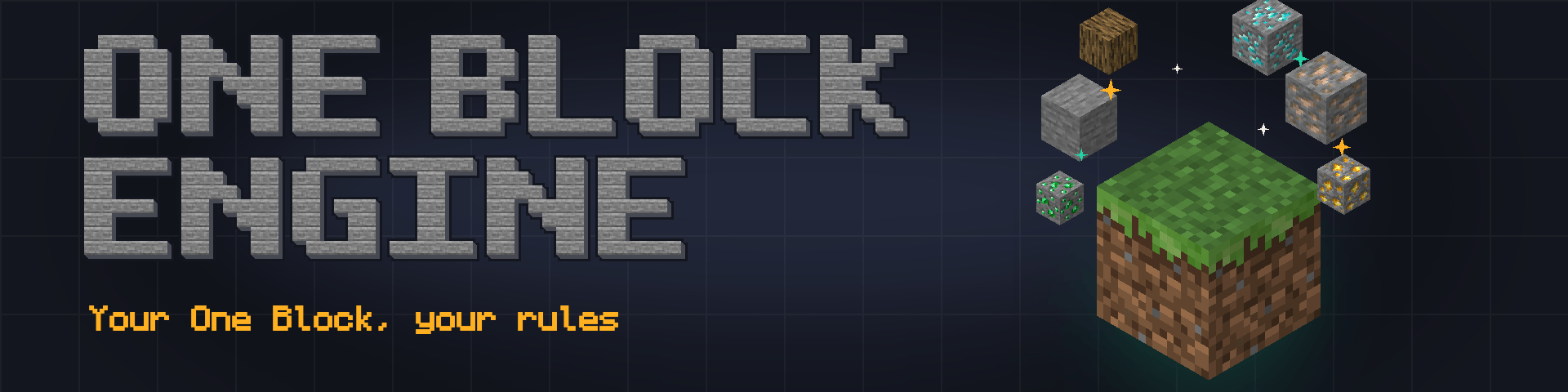
One Block Engine adds a magic block that changes as you break it. Each phase has its own blocks, mobs, chests and rewards, and you move to the next phase after breaking a set number of blocks. The mod contains the engine only. The content (phases, blocks, mobs) comes from a mode, written in JSON in a datapack or edited in game.
Made by Eltyy, from the Eltyy studio.
/oneblock info, /oneblock view, /oneblock home, /oneblock modes. Players without the mod can still play: they get the commands and text messages.data/<namespace>/oneblock/modes/ of a datapack. A phase has an id, a name, an icon, a colour, the number of blocks to break, weighted blocks, mobs (chance per block, maximum in a radius), milestones and reward commands. A complete example (classic) ships with the mod.config/oneblock_engine.json: hidden upcoming phases, machines that count (or not) when they break the block, and a block reserved for its members./oneblock edit <mode>, operators): drag and drop to reorder phases. Add, copy and delete phases. Add blocks with a search or the block in your hand, adjust weights, mobs and reward commands. Undo and redo, simulate, copy the JSON, save. The editor keeps milestones and loot tables as they are (edit those in the JSON)./oneblock simulate <mode> draws the blocks a player would break.default_world_type in config/oneblock_engine-client.json) and choose its mode and height with a world preset in its datapack. Dedicated server: level-type=oneblock_engine:oneblock and spawn-protection=0./reload reloads modes and settings.OneBlockEvents with PHASE_CHANGED, BLOCK_GENERATED and MILESTONE_REACHED.In a One Block world, every player gets their own island on first join, spaced along the X axis (1000 blocks by default). Other settings: a shared island for everyone, or a single block without islands.
/island. Tabs: My island, Invite, Requests, Banned, Islands.Progress belongs to the block: everyone who breaks it moves it forward, so co-op needs no setup.
The licence is All Rights Reserved, but modpacks may include One Block Engine, on Modrinth and on CurseForge. If you want to redistribute it another way, ask us first.
One Block Engine ajoute un bloc magique qui change à mesure que tu le casses. Chaque phase a ses blocs, ses créatures, ses coffres et ses récompenses, et tu passes à la suivante après un certain nombre de blocs cassés. Le mod contient le moteur seulement. Le contenu (phases, blocs, créatures) vient d'un mode, écrit en JSON dans un datapack ou modifié en jeu.
Fait par Eltyy, du studio Eltyy.
/oneblock info, /oneblock view, /oneblock home, /oneblock modes. Un joueur sans le mod peut jouer : il a les commandes et les messages en texte.data/<espace>/oneblock/modes/ d'un datapack. Une phase a un identifiant, un nom, une icône, une couleur, un nombre de blocs à casser, des blocs pondérés, des créatures (chance par bloc, maximum dans un rayon), des paliers et des commandes de récompense. Un exemple complet (classic) est livré avec le mod.config/oneblock_engine.json : phases à venir cachées, machines qui comptent (ou non) quand elles cassent le bloc, bloc réservé à ses membres./oneblock edit <mode>, opérateurs) : glisser-déposer pour réordonner les phases. Ajouter, copier et supprimer des phases. Ajouter des blocs avec une recherche ou le bloc en main, régler les poids, les créatures et les commandes de récompense. Annuler, rétablir, simuler, copier le JSON, enregistrer. L'éditeur garde tels quels les paliers et les tables de butin (à modifier dans le JSON)./oneblock simulate <mode> tire les blocs qu'un joueur casserait.default_world_type dans config/oneblock_engine-client.json) et choisir son mode et sa hauteur avec un préréglage de monde dans son datapack. Serveur dédié : level-type=oneblock_engine:oneblock et spawn-protection=0./reload recharge les modes et les réglages.OneBlockEvents avec PHASE_CHANGED, BLOCK_GENERATED et MILESTONE_REACHED.Dans un monde One Block, chaque joueur a sa propre île à sa première connexion. Les îles sont alignées sur l'axe X (tous les 1000 blocs par défaut). Autres réglages : une île commune pour tout le monde, ou un seul bloc sans îles.
/island. Onglets : Mon île, Inviter, Demandes, Bannis, Îles.La progression appartient au bloc : tous ceux qui le cassent la font avancer, donc le coop ne demande aucun réglage.
La licence est « tous droits réservés », mais les modpacks peuvent inclure One Block Engine, sur Modrinth comme sur CurseForge. Pour une autre redistribution, demande-nous d'abord.
Project description from CurseForge.
Pick your setup
Choose the version and loader you play, then open the matching release.
Check the dependencies, then try the file in a copied instance before changing a world you care about.
Recent files
oneblock-engine-fabric-1.1.0.jar
9 Nov 2026
oneblock-engine-neoforge-1.1.0.jar
9 Nov 2026
oneblock-engine-fabric-1.0.0.jar
26 Oct 2026
oneblock-engine-neoforge-1.0.0.jar
26 Oct 2026
Looking for an older file? The official CurseForge project page is in Resources.
 mod
This mod is the Core Mod used for all the Custom Recipes used in ModernGamingWorld's modpacks
 mod
A NeoForge mod that adds batch processing to Mekanism machines. Instead of processing items one at a time, machines process multiple items per operation based on their tier.
 mod
This mod allows the modification of item attributes, both vanilla and curios. Do you want to buff or nerf a weapon or curios? With this mod, you only need a datapack to do so.